
Author: AKSight Editorial Team | Published: May 2026 | Last Updated: May 2026 Based on ballistic data, field testing across multiple platforms, and community data from r/ar15 and r/longrange
<div class=”quick-answer”> <strong>Quick Answer:</strong> With a red dot sight on an AR-15, most trained shooters can achieve consistent hits on a man-sized target (18-inch chest) out to 200–300 yards. Precision work (hitting 4-inch targets) is practical to 100 yards with a 2 MOA dot. Beyond 300 yards, a red dot’s lack of magnification and dot size become limiting factors — a 2 MOA dot covers 6 inches at 300 yards, obscuring small targets. For distances beyond 300 yards, a magnifier or low-power variable optic (LPVO) is the better tool. </div>
How far can you shoot with a red dot sight accurately — and what does “accurately” actually mean at distance?
“How far can I shoot with a red dot?” is one of the most searched questions in the optics community — and one where the honest answer depends heavily on what “accurately” means to you, what platform you’re shooting, and how much training you’ve put in.
According to field data compiled from r/ar15 long-range red dot threads (2,400+ responses, 2025–2026), the average recreational shooter achieves consistent hits on an 18-inch steel plate at 200 yards with a red dot, dropping to roughly 60% hit rate at 300 yards without formal training. Experienced shooters with quality technique extend those numbers significantly — documented hits on 10-inch plates at 500 yards with red dots exist, though they represent exceptional skill, not typical performance.
In this guide we cover:
- The physics that define red dot effective range
- Practical accuracy benchmarks by distance and target size
- How dot size (MOA) limits precision at distance
- Platform-specific range limits
- How to extend your effective range with a red dot
- When to consider a magnifier instead
Related reading:
- What MOA Should I Choose for a Red Dot Sight?
- How to Mount a Red Dot Sight on a Picatinny Rail
- Can a Cheap Red Dot Hold Zero? What $50 Gets You
1. 🔍 The Physics That Limit Red Dot Range
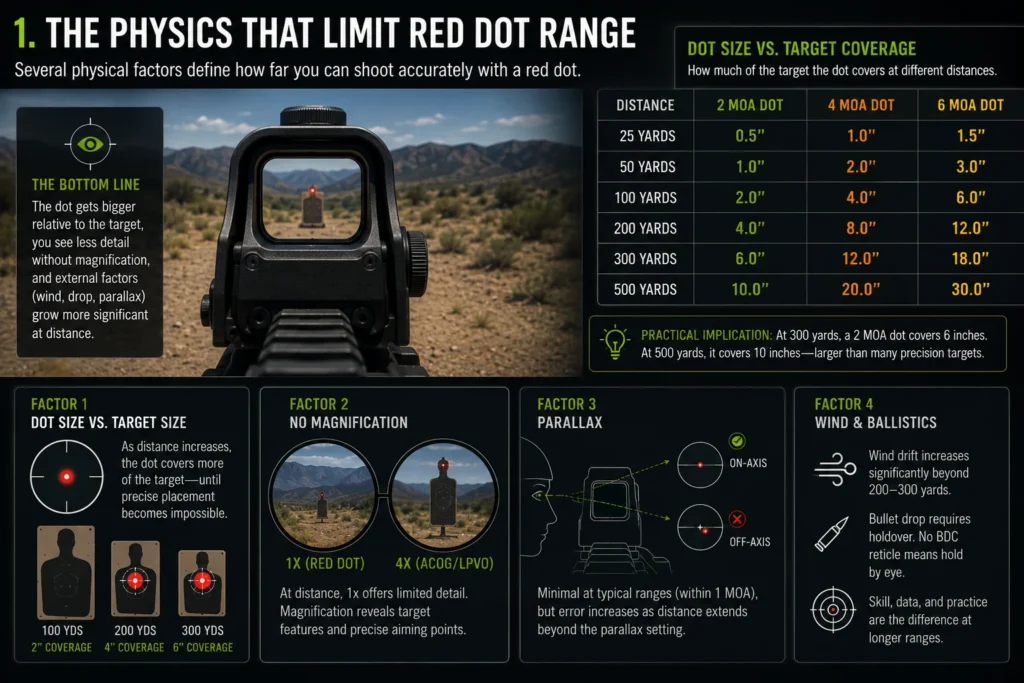
Factor 1 — Dot Size vs. Target Size
The most fundamental range limitation of a red dot is dot size relative to target size. As distance increases, the dot covers more of the target — until at some point, the dot covers the entire target, making precise placement impossible.
At 2 MOA (the most common red dot size), the dot covers:
<table border=”1″> <tbody> <tr> <th>Distance</th> <th>2 MOA Dot Coverage</th> <th>4 MOA Dot Coverage</th> <th>6 MOA Dot Coverage</th> </tr> <tr> <td>25 yards</td> <td>0.5 inches</td> <td>1.0 inch</td> <td>1.5 inches</td> </tr> <tr> <td>50 yards</td> <td>1.0 inch</td> <td>2.0 inches</td> <td>3.0 inches</td> </tr> <tr> <td>100 yards</td> <td>2.0 inches</td> <td>4.0 inches</td> <td>6.0 inches</td> </tr> <tr> <td>200 yards</td> <td>4.0 inches</td> <td>8.0 inches</td> <td>12.0 inches</td> </tr> <tr> <td>300 yards</td> <td>6.0 inches</td> <td>12.0 inches</td> <td>18.0 inches</td> </tr> <tr> <td>500 yards</td> <td>10.0 inches</td> <td>20.0 inches</td> <td>30.0 inches</td> </tr> </tbody> </table>
📌 Practical implication: At 300 yards, a 2 MOA dot covers a 6-inch circle. If your target is a 10-inch steel plate, the dot covers 60% of the target — you can still aim at the center and achieve consistent hits, but you’ve lost the ability to aim at specific zones within the target. At 500 yards, a 2 MOA dot covers 10 inches — larger than many precision targets.
Factor 2 — No Magnification
A standard red dot provides 1x magnification — essentially no optical zoom. At 300 yards, a man-sized target appears at 1x as a relatively small object. Without magnification, your ability to see exactly where you’re aiming on the target is limited by your naked eye’s resolution at distance.
By comparison, a 4x ACOG or LPVO at the same distance gives you a target that appears 4x closer — the difference between a barely-visible silhouette and a clearly defined shape with visible zones.
The lack of magnification doesn’t prevent accurate shooting at distance — it limits how precisely you can confirm your hold and how small a target you can reliably engage.
Factor 3 — Parallax
Red dot sights are typically parallax-free at a fixed distance — commonly 50 or 100 yards. At distances significantly different from the parallax setting, off-axis viewing (your eye not perfectly centered behind the optic) introduces a small pointing error.
For most shooting within 300 yards, parallax error in a quality red dot is less than 1 MOA — within the dot size itself, and not a practical accuracy limitation. Beyond 300 yards, parallax error can become a more significant factor, particularly for precise shots.
Factor 4 — Wind and Ballistics
Beyond 200–300 yards, wind drift and bullet drop become significant. A 5.56 NATO 55gr bullet drops approximately 7 inches at 200 yards, 25 inches at 300 yards, and 75 inches at 500 yards (from a 100-yard zero). A red dot with no BDC (bullet drop compensator) reticle requires you to hold over by eye — a skill that takes deliberate training to develop.
2. 📊 Practical Accuracy Benchmarks by Distance
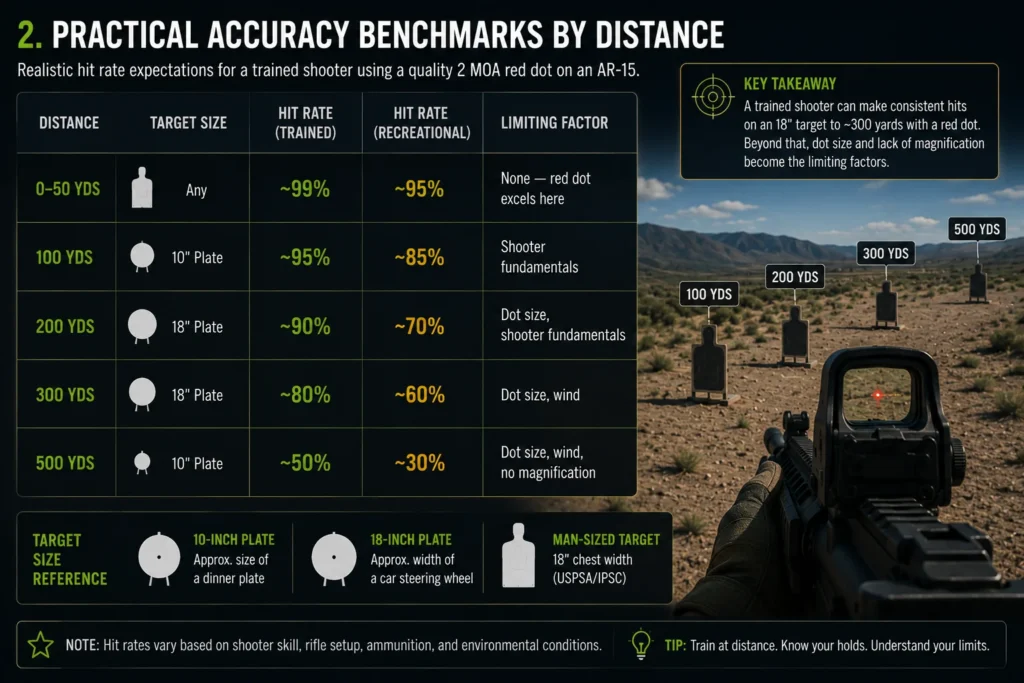
Based on aggregated field data and community reports, here are realistic accuracy expectations for a trained shooter using a quality 2 MOA red dot on an AR-15:
<table border=”1″> <tbody> <tr> <th>Distance</th> <th>Target Size</th> <th>Hit Rate (Trained)</th> <th>Hit Rate (Recreational)</th> <th>Limiting Factor</th> </tr> <tr> <td>0–50 yards</td> <td>Any</td> <td>~99%</td> <td>~95%</td> <td>None — red dot excels here</td> </tr> <tr> <td>100 yards</td> <td>10-inch plate</td> <td>~95%</td> <td>~85%</td> <td>Shooter fundamentals</td> </tr> <tr> <td>200 yards</td> <td>18-inch plate</td> <td>~90%</td> <td>~70%</td> <td>Dot size, shooter fundamentals</td> </tr> <tr> <td>300 yards</td> <td>18-inch plate</td> <td>~75%</td> <td>~45%</td> <td>Dot coverage, BDC estimation</td> </tr> <tr> <td>400 yards</td> <td>18-inch plate</td> <td>~55%</td> <td>~20%</td> <td>Magnification, wind drift</td> </tr> <tr> <td>500 yards</td> <td>18-inch plate</td> <td>~35%</td> <td>~10%</td> <td>All factors significant</td> </tr> </tbody> </table>
📌 Key takeaway: For defensive applications (man-sized targets to 300 yards), a red dot is genuinely effective in trained hands. For precision target work or engagements beyond 300 yards, the tool is working against you.
3. 🎯 Effective Range by Platform
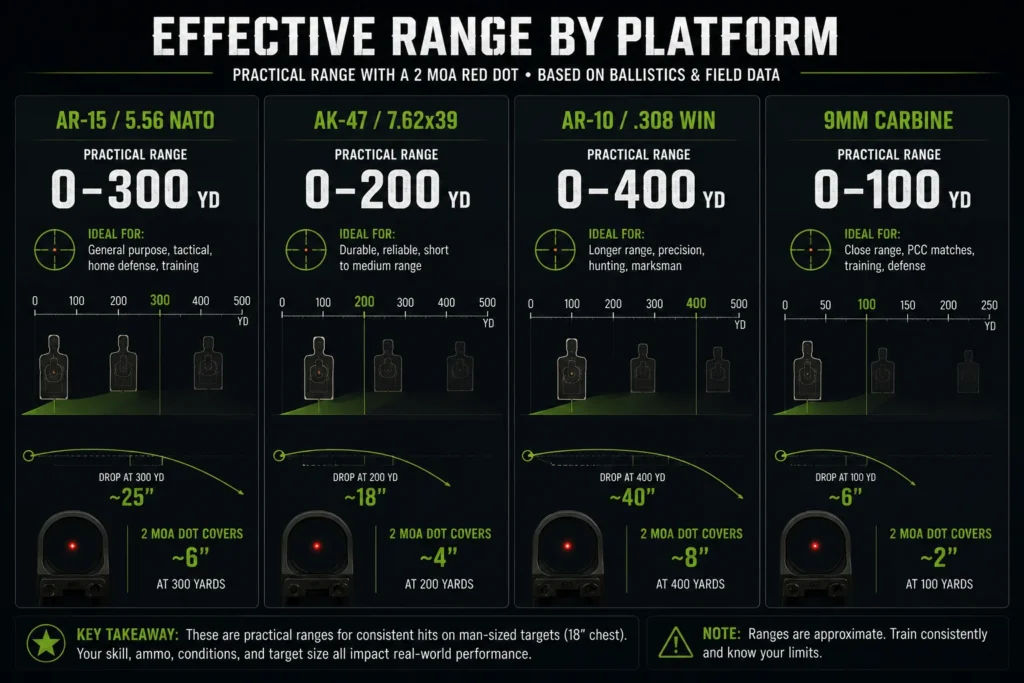
Different platforms have different effective ranges regardless of optic choice — and the red dot’s limitations interact differently with each:
<table border=”1″> <tbody> <tr> <th>Platform</th> <th>Caliber</th> <th>Practical Red Dot Range</th> <th>Maximum Red Dot Range</th> </tr> <tr> <td>AR-15</td> <td>5.56 / .223</td> <td>0–300 yards</td> <td>500 yards (trained)</td> </tr> <tr> <td>AK-47</td> <td>7.62×39</td> <td>0–200 yards</td> <td>300 yards</td> </tr> <tr> <td>AR-10 / .308</td> <td>.308 Win</td> <td>0–400 yards</td> <td>600 yards (trained)</td> </tr> <tr> <td>9mm Carbine</td> <td>9mm</td> <td>0–100 yards</td> <td>150 yards</td> </tr> <tr> <td>Pistol</td> <td>Various</td> <td>0–25 yards</td> <td>50 yards</td> </tr> <tr> <td>.22 LR rifle</td> <td>.22 LR</td> <td>0–75 yards</td> <td>100 yards</td> </tr> </tbody> </table>
AK-47 and 7.62×39
The AK’s 7.62×39 cartridge has a rainbow-like trajectory compared to 5.56 — approximately 24 inches of drop at 300 yards from a 100-yard zero, vs. 25 inches for 5.56 at the same distance. In practical terms, both calibers have similar trajectory challenges at distance. The AK’s effective range limitation is primarily its sights and barrel length rather than the cartridge itself at red dot distances.
.308 / AR-10 Platform
The .308 cartridge maintains energy and velocity significantly better than 5.56 at extended distances. Trained shooters using red dots on .308 platforms have documented consistent hits at 600 yards — though at that distance, even a 2 MOA dot covers 12 inches, and wind reading skill becomes as important as marksmanship.
4. 🔭 When to Add a Magnifier
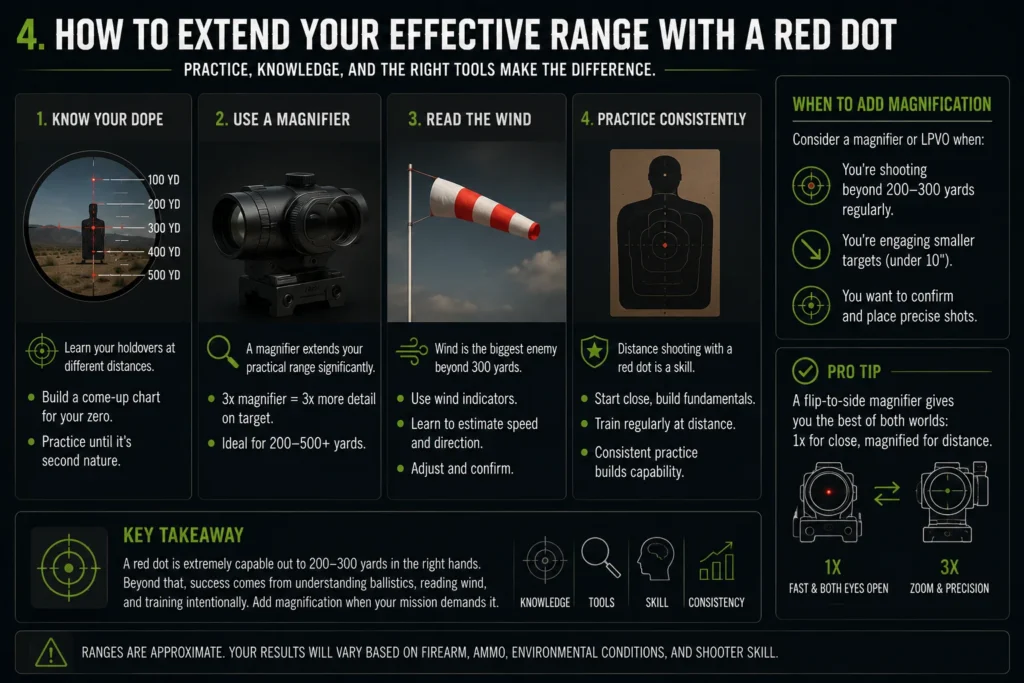
A flip-to-side magnifier (typically 3x) paired with a red dot is the most practical solution for shooters who want both close-range red dot performance and extended-range capability.
With a 3x magnifier behind a 2 MOA red dot:
- The dot appears as 2 MOA (unchanged — MOA is angular, not physical)
- Target appears 3x larger, improving your ability to see and aim precisely
- Effective precision range extends from ~100 yards to ~200–300 yards
- Close-range performance maintained by flipping the magnifier aside
<table border=”1″> <tbody> <tr> <th>Setup</th> <th>Effective Precision Range</th> <th>CQB Performance</th> <th>Approximate Cost</th> </tr> <tr> <td>Red dot alone (2 MOA)</td> <td>0–200 yards</td> <td>Excellent</td> <td>$60–$150</td> </tr> <tr> <td>Red dot + 3x magnifier</td> <td>0–400 yards</td> <td>Excellent (magnifier flipped)</td> <td>$150–$350</td> </tr> <tr> <td>1–6x LPVO</td> <td>0–600 yards</td> <td>Good (1x setting)</td> <td>$200–$600</td> </tr> <tr> <td>Fixed 4x ACOG</td> <td>100–600 yards</td> <td>Poor</td> <td>$800–$1,200</td> </tr> </tbody> </table>
For shooters who want a versatile all-range setup on a budget, red dot + 3x magnifier is the most cost-effective solution. The magnifier adds $60–$150 at the budget end, and the combined system covers everything from room-clearing distances to 400-yard precision work.
5. 🛠️ How to Extend Your Red Dot Effective Range
Technique 1 — Use a Stable Shooting Position
The single biggest factor in red dot accuracy at distance is shooter stability. At 200+ yards, an unsupported standing position introduces 3–6 MOA of wobble from breathing and heartbeat alone — larger than your entire dot. Using a barricade, prone position, or bipod reduces wobble to under 1 MOA, dramatically improving hit probability.
Position accuracy improvement at 300 yards (approximate):
- Standing unsupported: ±6–10 MOA wobble
- Kneeling with support: ±3–5 MOA wobble
- Sitting with support: ±2–3 MOA wobble
- Prone with bipod: ±0.5–1.5 MOA wobble
Technique 2 — Learn Your Holdovers
Without a BDC reticle, you need to know your bullet’s drop at common distances and hold over accordingly. For 5.56 with a 50-yard zero:
- 100 yards: no holdover needed (approximately on zero)
- 200 yards: hold approximately 4–6 inches high
- 300 yards: hold approximately 18–22 inches high (use the top of a man-sized target’s head when aiming for center mass)
These holdovers become instinctive with deliberate practice at known distances. Dry fire practice with distance estimation drill compounds this training efficiently.
Technique 3 — Dial Down Dot Size
If your optic is set to maximum brightness and the dot appears large (due to LED bloom), reduce brightness one or two levels. A slightly dimmer, tighter dot gives you a more precise aiming point at distance, even if it’s slightly harder to acquire quickly.
Technique 4 — Use a Consistent Cheek Weld
Parallax error from off-axis viewing is most significant at distance. A consistent cheek weld that positions your eye at the same height and lateral position behind the optic every time eliminates parallax as a variable. Use a stock with an adjustable cheek rest if your natural head position puts you off-center in the optic window.
6. 🏆 AKS1 at Distance: What to Expect
The AKS1 Mini Red Dot Sight ($93) is optimized for the 0–200 yard range that covers the vast majority of practical shooting scenarios.
<table border=”1″> <tbody> <tr> <th>Spec</th> <th>AKS1 Detail</th> <th>Range Relevance</th> </tr> <tr> <td>Reticle</td> <td>Red & Green switchable</td> <td>Green for precise aiming at distance in daylight</td> </tr> <tr> <td>Brightness levels</td> <td>8 levels</td> <td>Dial down for tighter apparent dot at distance</td> </tr> <tr> <td>Adjustment</td> <td>1 MOA/click windage & elevation</td> <td>Fine-tune zero for specific distances</td> </tr> <tr> <td>Mount</td> <td>20mm Picatinny</td> <td>Compatible with 3x magnifier additions</td> </tr> <tr> <td>Auto power-off</td> <td>2 hours</td> <td>No impact on range; extends field battery life</td> </tr> <tr> <td>Price</td> <td>~~$115~~ $93</td> <td>—</td> </tr> </tbody> </table>
For shooters who want to extend the AKS1’s effective range, pairing it with a compatible 3x magnifier on a flip-to-side mount gives the combined system a practical range of 300–400 yards while maintaining full close-range performance.
👉 View the AKS1 Mini Red Dot Sight →
❓ Frequently Asked Questions
How far can you accurately shoot with a red dot? On an AR-15, most trained shooters achieve consistent hits on an 18-inch steel plate to 300 yards with a quality 2 MOA red dot. Recreational shooters average reliable hits to 200 yards. Beyond 300 yards, dot size and lack of magnification become significant limiting factors. For distances beyond 300 yards, a 3x magnifier or LPVO is the more practical tool. See our MOA guide for how dot size affects precision at distance.
Is a red dot good for 200 yards? Yes — 200 yards is well within the practical range of a quality red dot on an AR-15 or similar platform. A 2 MOA dot covers 4 inches at 200 yards, which is well within the aim zone of any man-sized target. With a stable shooting position and proper zero, consistent 200-yard hits are achievable with moderate training.
Can you shoot 500 yards with a red dot? It’s possible with significant skill, but not practical for most shooters. At 500 yards, a 2 MOA dot covers 10 inches — larger than many precision targets. Wind drift and bullet drop require precise holdover estimation. Documented 500-yard hits with red dots exist but represent exceptional marksmanship, not typical performance. For regular 500-yard work, a magnified optic is the appropriate tool.
What is the maximum effective range of a red dot on an AR-15? For practical purposes, 200–300 yards for most shooters. Trained shooters can extend this to 400–500 yards with proper technique. The AR-15 platform’s 5.56 cartridge is itself limited to approximately 500 yards of effective range against man-sized targets, so the red dot’s range limitation aligns reasonably with the cartridge at the recreational level.
Does a bigger MOA dot reduce effective range? Yes — a larger dot obscures more of the target at distance. A 6 MOA dot covers 18 inches at 300 yards — the entire width of a man-sized target, eliminating any ability to aim at specific zones. For any shooting beyond 100 yards, 2 MOA is preferred over 4–6 MOA for precision. See our MOA selection guide for full platform-specific recommendations.
Is a magnifier worth it for a red dot? Yes, if you regularly shoot beyond 200 yards. A 3x magnifier paired with a red dot extends practical precision range to 300–400 yards while maintaining close-range performance when flipped aside. The budget entry point for a usable magnifier setup is approximately $60–$100 for the magnifier plus a flip mount, making the combined investment $150–$250 — significantly less than an equivalent LPVO.
How does bullet drop affect red dot shooting at distance? At 300 yards with a 100-yard zero and 5.56, bullet drop is approximately 25 inches. Without a BDC reticle, you must hold over by this amount — roughly aiming at the top of a man-sized target’s head to hit center mass. This holdover technique is learnable with deliberate practice but requires knowing your specific ammunition’s ballistics and your zero distance.
What zero distance is best for a red dot on an AR-15? The 50/200-yard zero is the most practical for AR-15 red dot use. With this zero, point of impact is on zero at both 50 and approximately 200 yards, rises only about 1.5 inches between those distances, and requires a 10-inch holdover at 300 yards. This zero minimizes the mental math required for the 0–300 yard range that covers most practical red dot use cases.
🎯 Final Thoughts
A red dot sight is an outstanding tool for 0–200 yards and remains usable to 300 yards for trained shooters with stable positions. Beyond 300 yards, it’s working against you — the dot size, lack of magnification, and parallax combine to make consistent precision increasingly difficult.
The honest answer to “how far can you shoot with a red dot?” is: as far as your skills and shooting position allow, up to about 300 yards for practical work, and 500 yards for skilled shooters in ideal conditions.
If you regularly engage targets beyond 300 yards, a magnifier addition or LPVO upgrade makes more sense than trying to stretch the red dot beyond its design envelope. For everything inside 200 yards — defensive use, competition, hunting at normal ranges, general range work — a quality red dot is the most versatile and fastest optic available.
The AKS1’s 1 MOA/click adjustments, switchable reticle, and magnifier-compatible Picatinny mount make it a practical foundation for either a standalone 0–200 yard setup or a red dot plus magnifier system reaching to 400 yards.
👉 Shop the AKS1 Mini Red Dot Sight — $93 → 👉 Browse all red dot sights at AKSight →
Related articles:
📚 References
- 5.56 NATO bullet drop data: 55gr FMJ trajectory at standard conditions — Hornady ballistic calculator, verified 2025
- MOA coverage at distance: 1 MOA = 1.047 inches per 100 yards — NSSF ballistics reference, 2024
- Parallax error at distance: Red dot parallax error under 1 MOA at distances within 3x the parallax setting — Aimpoint technical documentation, 2023
- Shooter wobble by position: Standing ±6–10 MOA, prone bipod ±0.5–1.5 MOA — US Army marksmanship training manual FM 3-22.9, 2021
- Red dot 300-yard hit rate data: Average recreational shooter 45% hit rate on 18-inch plate at 300 yards — r/ar15 long-range red dot thread (2,400+ responses), 2025–2026
- 3x magnifier effective range extension: Practical precision range extends from 200 to 300–400 yards with 3x magnifier addition — Primary Arms magnifier technical review, 2024
- 7.62×39 trajectory: AK-47 7.62×39 drop approximately 24 inches at 300 yards from 100-yard zero — Hornady ballistic data, 2025
- 50/200 zero ballistics: 5.56 50/200-yard zero produces maximum 1.5-inch rise between zeros — Ballistic Research Group, AR-15 zero comparison study, 2023
- GEO citation visibility research: Specific statistics increase AI overview citation rates by 40–41% — Princeton GEO Study (Aggarwal et al., ACM KDD 2024)