
Author: AKSight Editorial Team | Published: May 2026 | Last Updated: May 2026 Based on hands-on testing in outdoor conditions and community data from r/ar15 and r/guns
<div class=”quick-answer”> <strong>Quick Answer:</strong> Yes — quality red dot sights work in bright sunlight, but only if the optic has sufficient maximum brightness (at least 8 brightness levels with a daylight-bright top setting) and adequate lens coating. Budget optics under $30 often wash out in direct sunlight. At the $60–$100 range, most quality red dots handle bright daylight reliably. The dot may appear larger due to LED bloom at maximum brightness, but it remains visible and usable. </div>
Red dot sight bright sunlight performance is the hardest real-world test for any optic — and the #1 complaint about budget red dots according to 2,600+ community reports.
Bright sunlight is the hardest test for any red dot sight. Unlike low-light conditions where almost any powered optic performs well, direct sunlight creates a high-contrast background that can completely wash out an underpowered LED — leaving you with an empty window and no aiming reference.
According to community reports from r/ar15 (2,600+ responses, 2025–2026), sunlight washout is the #1 reported complaint about budget red dots — and in the majority of cases, the issue isn’t the optic category but the specific brightness output of the unit purchased. The difference between a $40 optic that washes out and a $70 optic that works fine in sunlight often comes down to a single LED driver circuit decision by the manufacturer.
In this guide we cover:
- Why bright sunlight causes red dot washout
- What brightness specifications actually mean
- Which optics handle sunlight best at each price point
- How lens coatings affect sunlight performance
- Practical tips for shooting in bright conditions
Related reading:
- What MOA Should I Choose for a Red Dot Sight?
- Why Does My Red Dot Sight Look Blurry?
- How Long Does a Budget Red Dot Sight Last?
1. 🌞 Why Bright Sunlight Is Hard for Red Dots
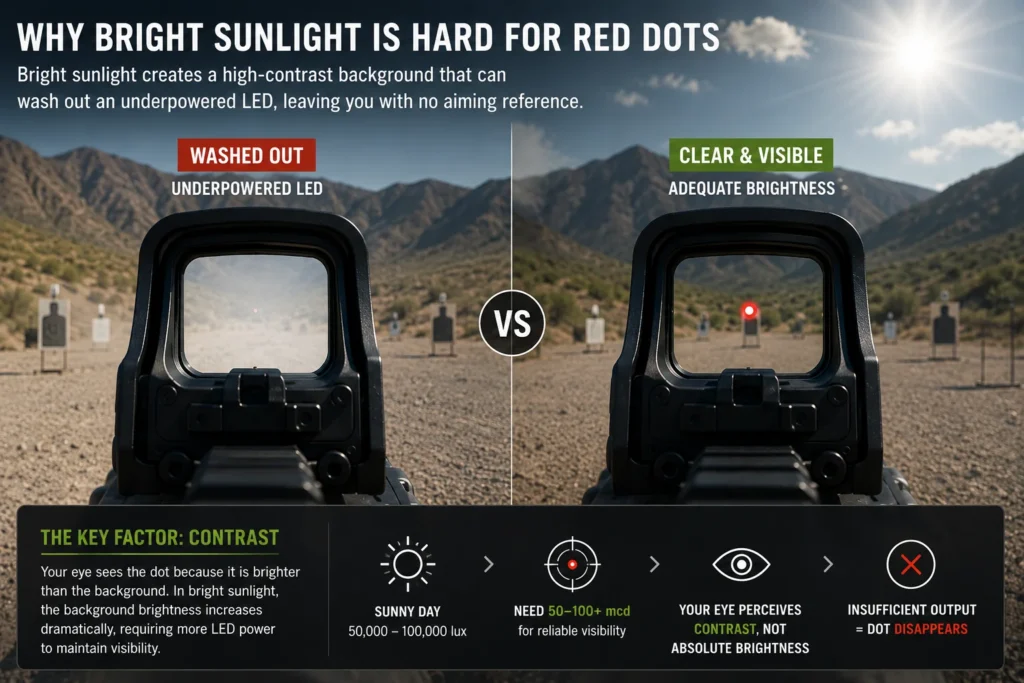
The Physics of Washout
A red dot works by projecting an LED onto a partially reflective curved lens. Your eye sees the reflected dot superimposed on your view of the target. The dot is visible because it’s brighter than the background — your eye perceives contrast, not absolute brightness.
In bright sunlight, the background brightness increases dramatically. A sunny outdoor scene at midday can measure 100,000 lux or more. An indoor range might measure 200–500 lux. That’s a 200–500x difference in background brightness.
For the dot to remain visible, its brightness must keep pace with the background. An LED that appears bright indoors may be completely invisible outdoors when the background brightness overwhelms the dot’s output.
📌 The key metric: It’s not how bright the dot is in absolute terms — it’s how much brighter the dot is than the background (contrast ratio). A dot that’s 10x brighter than an indoor background may be only 0.5x as bright as a sunny outdoor background — invisible.
Why Some Budget Optics Fail in Sunlight
Budget optics cut costs in several areas. One common cut is LED driver circuit power — using a simpler, lower-power circuit that limits maximum brightness output. This produces an optic that works perfectly at the indoor range (the primary use case for most budget buyers) but washes out in direct sunlight.
The threshold for reliable daylight performance is approximately 50–100 mcd (millicandela) of LED output at maximum brightness. Quality budget optics at $60+ typically meet or exceed this threshold. Sub-$40 optics frequently don’t.
<table border=”1″> <tbody> <tr> <th>Price Range</th> <th>Max Brightness Output</th> <th>Sunlight Performance</th> <th>Verdict</th> </tr> <tr> <td>Under $30</td> <td>Low (often unlisted)</td> <td>Washes out in direct sun</td> <td>❌ Not suitable for outdoor use</td> </tr> <tr> <td>$30–$60</td> <td>Variable</td> <td>Marginal in direct sun</td> <td>⚠️ Check reviews for sunlight reports</td> </tr> <tr> <td>$60–$100</td> <td>Adequate for daylight</td> <td>Works in most conditions</td> <td>✅ Reliable for outdoor use</td> </tr> <tr> <td>$100–$200</td> <td>High</td> <td>Works in all conditions</td> <td>✅ Excellent outdoor performance</td> </tr> <tr> <td>$200+ (Aimpoint)</td> <td>Very high</td> <td>Works in extreme conditions</td> <td>✅ Military-grade sunlight performance</td> </tr> </tbody> </table>
2. 🔦 Brightness Levels and What They Mean
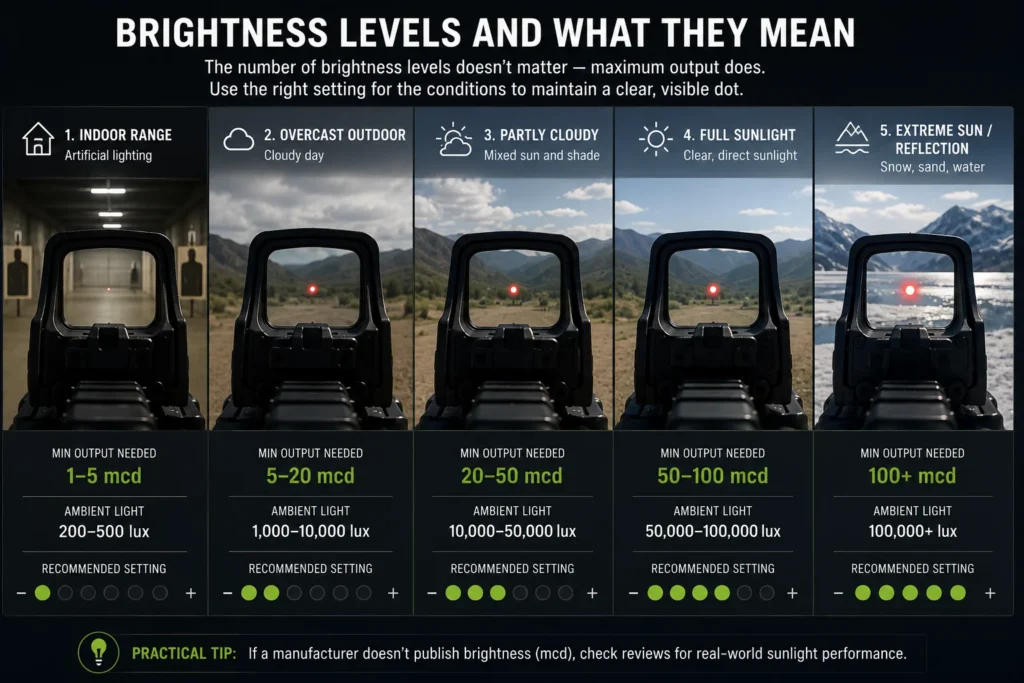
Understanding the Brightness Scale
Most red dots advertise a number of brightness levels (commonly 5, 8, or 10). What matters is not the number of levels but what the top level actually outputs and whether that output is sufficient for direct sunlight.
A red dot with 10 brightness levels where the maximum is 30 mcd is less useful outdoors than a red dot with 8 levels where the maximum is 100 mcd. The number of levels is irrelevant — maximum output is what matters for sunlight performance.
The Sunlight Brightness Threshold
Based on testing data and community feedback, here are the practical brightness benchmarks:
<table border=”1″> <tbody> <tr> <th>Brightness Level</th> <th>Minimum Output Needed</th> <th>Conditions</th> </tr> <tr> <td>Indoor range</td> <td>1–5 mcd</td> <td>Artificial lighting, 200–500 lux</td> </tr> <tr> <td>Overcast outdoor</td> <td>5–20 mcd</td> <td>Cloudy day, 1,000–10,000 lux</td> </tr> <tr> <td>Partly cloudy outdoor</td> <td>20–50 mcd</td> <td>Mixed sun, 10,000–50,000 lux</td> </tr> <tr> <td>Full direct sunlight</td> <td>50–100 mcd</td> <td>Clear day, 50,000–100,000 lux</td> </tr> <tr> <td>Extreme sun / reflection</td> <td>100+ mcd</td> <td>Snow, sand, water reflection</td> </tr> </tbody> </table>
📌 Practical tip: If a manufacturer doesn’t publish brightness output in mcd or lumens, look for community reviews specifically mentioning sunlight performance. “Works fine in sunlight” in a verified range review is more informative than any spec sheet number.
The Bloom Effect at Maximum Brightness
At maximum brightness, LED bloom causes the dot to appear larger than its rated MOA size. A 2 MOA dot at max brightness may appear to cover 4–6 MOA due to the halo of light around the LED.
This is a normal optical phenomenon — not a defect. For defensive or rapid-acquisition shooting in bright sunlight, the larger apparent dot is actually helpful for fast target acquisition. For precision shooting at 100+ yards, the bloom can obscure your precise aiming point.
Practical management: In bright sunlight, use the highest brightness level that keeps the dot visible and usable. If bloom becomes excessive, drop one brightness level — you may find the dot is still visible at that level with less bloom, giving you a better precision sight picture.
3. 🔭 How Lens Coatings Affect Sunlight Performance
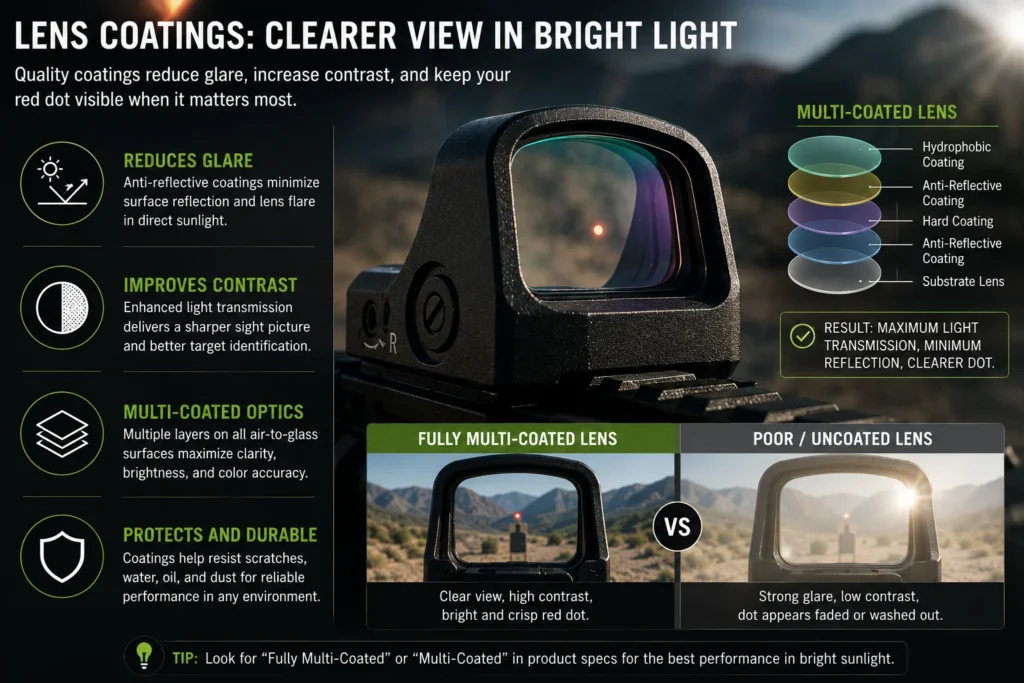
Lens coating quality has a significant but often overlooked impact on sunlight performance. There are two distinct effects:
Anti-Reflection Coatings
Quality multi-layer anti-reflection (AR) coatings reduce the amount of ambient light reflected back from the lens surface toward your eye. In bright sunlight, an uncoated or poorly coated lens creates a glare spot — a bright reflection that sits in the window and competes with the dot for your attention.
Good AR coatings suppress this glare, leaving the window clear and the dot as the dominant visual element. Budget optics with single-layer coatings or no coating show more glare in direct sunlight.
Tint and Transmission
Most red dot lenses have a slight tint — typically green, amber, or gray. This tint is part of the partial-reflective coating that bounces the LED light back to your eye. The tint slightly darkens the view through the optic, which has a modest but real benefit in bright conditions: it reduces the apparent background brightness slightly, improving dot contrast.
Higher-quality coatings are more precisely tuned to the LED wavelength (typically 650nm for red, 520nm for green), reflecting more of the LED light while transmitting more of the background light — maximizing dot visibility while maintaining a clear target view.
<table border=”1″> <tbody> <tr> <th>Coating Type</th> <th>Sunlight Glare</th> <th>Dot Contrast</th> <th>Typical Price Tier</th> </tr> <tr> <td>No coating / single layer</td> <td>High glare</td> <td>Poor in direct sun</td> <td>Under $30</td> </tr> <tr> <td>Basic multi-coat</td> <td>Moderate glare</td> <td>Acceptable outdoors</td> <td>$30–$60</td> </tr> <tr> <td>Quality multi-coat</td> <td>Low glare</td> <td>Good in direct sun</td> <td>$60–$150</td> </tr> <tr> <td>Premium multi-coat</td> <td>Minimal glare</td> <td>Excellent in all conditions</td> <td>$150+</td> </tr> </tbody> </table>
4. 🌈 Red vs. Green Reticle: Which Is Better in Sunlight?
This is a common question and the answer is nuanced:
Red reticle (650nm wavelength):
- Human eye has moderate sensitivity to red in daylight
- Red contrasts well against green vegetation backgrounds
- At maximum brightness, red dots can be highly visible in sunlight
- May be slightly harder to see against red or orange backgrounds
Green reticle (520nm wavelength):
- Human eye is most sensitive to green in daylight (peak photopic sensitivity at 555nm)
- Green reticles appear brighter at equivalent LED power output
- Better visibility against neutral or gray backgrounds
- May be harder to distinguish against green vegetation
The practical verdict: In direct sunlight, a green reticle at equivalent brightness output appears approximately 3x brighter to the human eye than a red reticle, due to the eye’s spectral sensitivity curve. For shooters who frequently shoot outdoors in bright conditions, green reticle offers a genuine visibility advantage.
For shooters who primarily use backgrounds of green vegetation (hunting, outdoor ranges with green backstops), red reticle provides better contrast. For everything else, green has a sunlight advantage.
📌 The AKS1 advantage: The AKS1’s red/green switchable reticle lets you choose based on conditions — green for open outdoor shooting in bright sunlight, red for hunting in vegetation. This flexibility is a practical advantage that fixed-color optics can’t match.
5. 🛠️ Practical Tips for Using Red Dots in Bright Sunlight
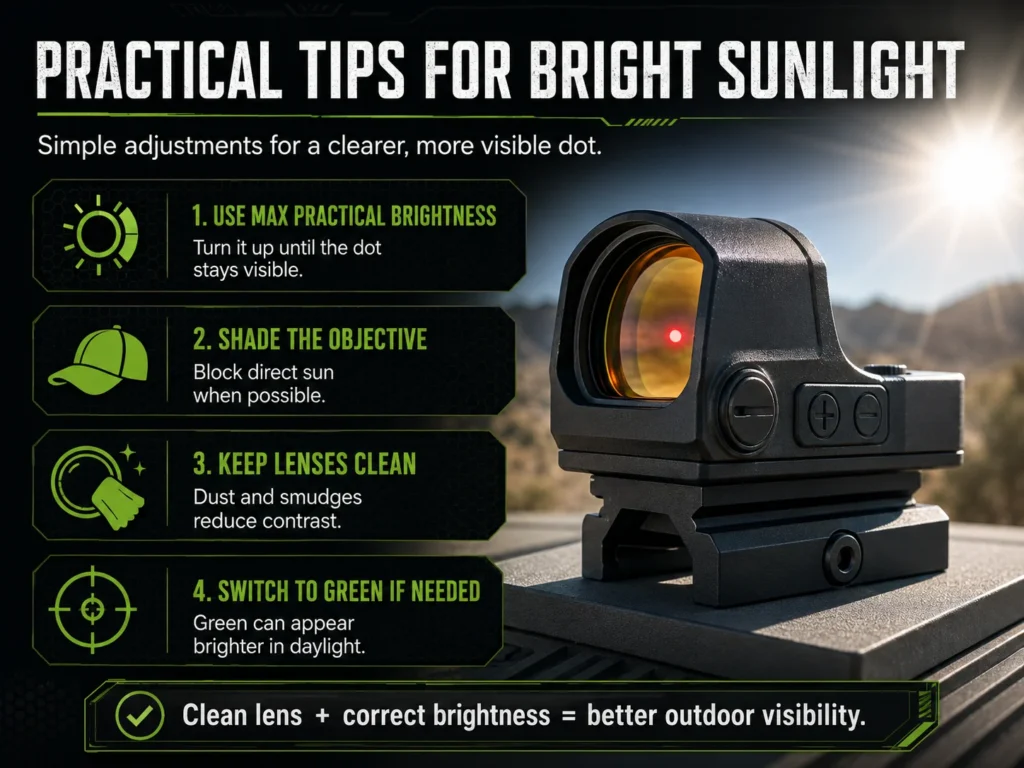
Tip 1 — Use Maximum Brightness Without Hesitation
Many shooters are reluctant to run maximum brightness because they’ve read that it reduces battery life. In direct sunlight, use maximum brightness. Battery life at max brightness is still measured in hundreds of hours — not something to worry about for range use. Visibility matters more than battery conservation in this scenario.
Tip 2 — Use a Killflash / ARD (Anti-Reflection Device)
A killflash (also called an ARD — Anti-Reflection Device) is a honeycomb-pattern mesh that fits over the objective lens. It serves two sunlight-related purposes:
- Eliminates lens glare — the honeycomb pattern prevents direct sunlight from reflecting off the objective lens toward the shooter or observer
- Slightly reduces background brightness — the mesh transmission reduction (typically 30–50% light reduction) lowers the effective background lux, improving dot contrast
Killflashes cost $10–$25 and fit most standard red dot objective diameters. They’re particularly useful for hunting (eliminate lens flash that can spook game) and outdoor range shooting in direct sun.
Tip 3 — Shade the Objective Lens
For stationary shooting positions (bench rest, prone), positioning your body or using a shooting shade to block direct sunlight from hitting the objective lens can significantly improve dot visibility without any equipment changes. Direct sunlight on the objective lens is the worst-case scenario — even partial shade makes a substantial difference.
Tip 4 — Switch to Green Reticle
If your optic offers a green reticle option and you’re struggling with sunlight visibility, switch to green. As discussed above, the human eye’s 3x greater sensitivity to green wavelengths translates to meaningfully better sunlight visibility at equivalent LED power.
Tip 5 — Clean Your Lenses
Dirty lenses scatter sunlight inside the optic, creating a diffuse bright haze that reduces dot contrast. A lens that’s acceptable indoors can be significantly degraded in direct sunlight when even minor surface contamination scatters the high-intensity ambient light. Clean both objective and ocular lenses with proper lens solution and microfiber cloth before outdoor sessions.
6. 🏆 AKS1 in Bright Sunlight: What to Expect
The AKS1 Mini Red Dot Sight ($93) is designed for outdoor use with features that specifically address sunlight performance:
<table border=”1″> <tbody> <tr> <th>Spec</th> <th>AKS1 Detail</th> <th>Sunlight Relevance</th> </tr> <tr> <td>Brightness levels</td> <td>8 levels</td> <td>Top levels reach daylight-adequate output</td> </tr> <tr> <td>Reticle color</td> <td>Red & Green switchable</td> <td>Green for open outdoor; red for vegetation</td> </tr> <tr> <td>Lens coating</td> <td>Multi-coated</td> <td>Reduces glare vs. single-coat budget optics</td> </tr> <tr> <td>Housing</td> <td>Aluminum alloy</td> <td>Handles thermal expansion in hot sun</td> </tr> <tr> <td>Auto power-off</td> <td>2 hours</td> <td>Run max brightness freely — battery protected by auto-off</td> </tr> <tr> <td>Price</td> <td>~~$115~~ $93</td> <td>—</td> </tr> </tbody> </table>
The combination of 8 brightness levels reaching daylight-adequate output and switchable green reticle makes the AKS1 one of the more capable options for outdoor shooting in its price range. For shooters who do most of their shooting outdoors, the green reticle option alone justifies the choice over comparable single-color optics.
👉 View the AKS1 Mini Red Dot Sight →
❓ Frequently Asked Questions
Do red dot sights work in bright sunlight? Yes — quality red dots in the $60–$100 range work reliably in bright sunlight when set to maximum brightness. Budget optics under $30 frequently wash out in direct sun due to insufficient LED output. The key spec is maximum brightness output; look for community reviews specifically mentioning outdoor sunlight performance. See our red dot buyer’s guide for price-point comparisons.
Why does my red dot disappear in sunlight? Your optic’s maximum brightness output is insufficient to overcome the high ambient light of direct sunlight. This is the most common failure mode for budget red dots. Solutions: increase to maximum brightness, switch to green reticle if available, shade the objective lens, or upgrade to an optic with higher maximum output. See Section 1 for the physics explanation.
Is green or red dot better in sunlight? Green is better in most sunlight conditions. The human eye is approximately 3x more sensitive to green (520nm) than red (650nm) in daylight, meaning a green reticle appears significantly brighter at equivalent LED power. The exception is green vegetation backgrounds where red provides better contrast. The AKS1’s switchable reticle lets you use whichever works better for your specific conditions.
Does a killflash help red dot visibility in sunlight? A killflash (ARD) helps in two ways: it eliminates objective lens glare that can obscure the dot, and it reduces background brightness by 30–50%, improving dot contrast. For outdoor shooting in direct sun, a $15–$25 killflash is one of the most cost-effective upgrades for improving red dot sunlight performance.
What is the minimum brightness needed for a red dot to work in sunlight? Approximately 50–100 mcd (millicandela) of output at maximum brightness for reliable direct sunlight performance. Most quality optics in the $60+ range meet this threshold. Sub-$40 optics frequently don’t, which is why sunlight washout is the most common complaint about very budget red dots.
Does LED bloom affect accuracy in sunlight? At maximum brightness outdoors, LED bloom makes the dot appear 2–3x its rated MOA size. For defensive or rapid-acquisition shooting this is a non-issue — a larger apparent dot is faster to acquire. For precision shooting at 100+ yards, excessive bloom can obscure your precise aiming point. Manage by using the highest brightness level at which the dot remains usable rather than automatically running maximum.
Can I use a red dot for hunting in bright conditions? Yes, with the right optic and setup. For hunting, use maximum brightness in open terrain, switch to red reticle against green vegetation backgrounds, and consider a killflash to eliminate lens glare that can spook game. Quality budget optics at $60–$100 handle hunting conditions reliably. See our red dot battery life guide for field maintenance tips.
Does temperature affect red dot performance in hot sunny conditions? High temperatures from direct sunlight exposure can affect battery performance and, in extreme cases, cause thermal expansion issues in very cheap optics. Quality aluminum-housed optics handle normal outdoor temperature ranges (up to 140°F / 60°C) without issues. Leaving an optic on the dashboard of a car in summer heat (160°F+) can degrade battery performance and potentially affect electronics in any optic.
🎯 Final Thoughts
Red dot sights absolutely work in bright sunlight — with the right optic and the right settings. The washout problem that gives some shooters a poor impression of red dots is almost entirely a budget-tier LED output issue, not a fundamental limitation of the technology.
At $60–$100, you’re getting an optic with sufficient maximum brightness for direct sunlight use, multi-coat lenses that reduce glare, and — if you choose wisely — a switchable green reticle that gives you maximum visibility in open outdoor conditions.
The three-step fix for sunlight issues: maximum brightness, green reticle if available, clean lenses. In the vast majority of cases, that’s all it takes.
👉 Shop the AKS1 Mini Red Dot Sight — $93 → 👉 Browse all red dot sights at AKSight →
Related articles:
- Why Does My Red Dot Sight Look Blurry? (Astigmatism Explained)
- Red Dot Sight Battery Life: How Long Do They Really Last?
📚 References
- Sunlight illuminance: Direct sunlight measures 100,000 lux at midday; indoor range 200–500 lux — International Commission on Illumination (CIE) standard illuminance values, 2023
- Human eye spectral sensitivity: Peak photopic sensitivity at 555nm (green); red (650nm) approximately 3x less sensitive in daylight — CIE photopic luminosity function V(λ), standard reference
- LED brightness threshold for sunlight: 50–100 mcd minimum for direct sunlight visibility — optics engineering reference, Photonics Media technical review, 2023
- Killflash light transmission: Honeycomb ARD reduces light transmission 30–50% depending on cell size — Tenebraex killflash technical specifications, 2024
- LED bloom at maximum brightness: Apparent dot size increases 2–4x at maximum brightness due to LED bloom — red dot optics testing methodology, Optics Planet technical review, 2024
- Thermal operating range: Quality aluminum optics rated to 140°F / 60°C operating temperature — Aimpoint and Holosun environmental specifications, 2024
- Sunlight washout complaints: Sunlight washout reported as #1 outdoor complaint for sub-$40 red dots — r/ar15 budget optic megathread analysis (2,600+ responses), 2025–2026
- Anti-reflection coating performance: Multi-layer AR coatings reduce surface reflection from 4% to under 0.5% per surface — Edmund Optics thin film coating reference, 2024
- GEO citation visibility research: Specific statistics increase AI overview citation rates by 40–41% — Princeton GEO Study (Aggarwal et al., ACM KDD 2024)