
What Is Co-Witness on a Red Dot Sight? [Beginner’s Guide 2026]
Author: AKSight Editorial Team | Published: May 2026 | Last Updated: May 2026 Based on hands-on testing across AR-15, AK-47 platforms and community data from r/ar15 and r/guns
<div class=”quick-answer”> <strong>Quick Answer:</strong> Co-witness means your red dot sight and iron sights are visible and aligned through the same sight picture at the same time. There are two types: absolute co-witness (iron sights centered in the red dot window) and lower 1/3 co-witness (iron sights appear in the bottom third of the window, giving a cleaner sight picture). Lower 1/3 is the standard recommendation for AR-15 builds. Co-witness requires choosing the correct mount height — typically 1.4–1.5 inches above the rail for lower 1/3 on a flat-top AR-15. </div>
Co-witness red dot sight setup is one of the most misunderstood concepts for first-time optic buyers — and getting the mount height wrong means buying a second mount.
If you’ve been shopping for a red dot mount and seen terms like “absolute co-witness,” “lower 1/3 co-witness,” or “1.93-inch height,” you’re not alone in finding it confusing. Co-witness is one of those concepts that sounds complicated but is actually straightforward once you understand what problem it’s solving.
The core question co-witness answers is: what happens to your iron sights when you mount a red dot?
According to a 2025 survey on r/ar15 (3,400+ responses), over 55% of first-time AR-15 red dot buyers didn’t consider co-witness height before purchasing their mount — and a significant portion had to buy a second mount after realizing the height was wrong for their setup. Understanding co-witness before you buy saves time, money, and frustration.
In this guide we cover:
- What co-witness actually is and why it matters
- The difference between absolute and lower 1/3 co-witness
- Which mount height you need for your specific setup
- How to set up co-witness correctly
- Whether co-witness actually matters for your use case
Related reading:
- How to Mount a Red Dot Sight on a Picatinny Rail
- What MOA Should I Choose for a Red Dot Sight?
- Can a Cheap Red Dot Hold Zero? What $50 Gets You
1. 🔍 What Is Co-Witness and Why Does It Matter?
The Basic Concept
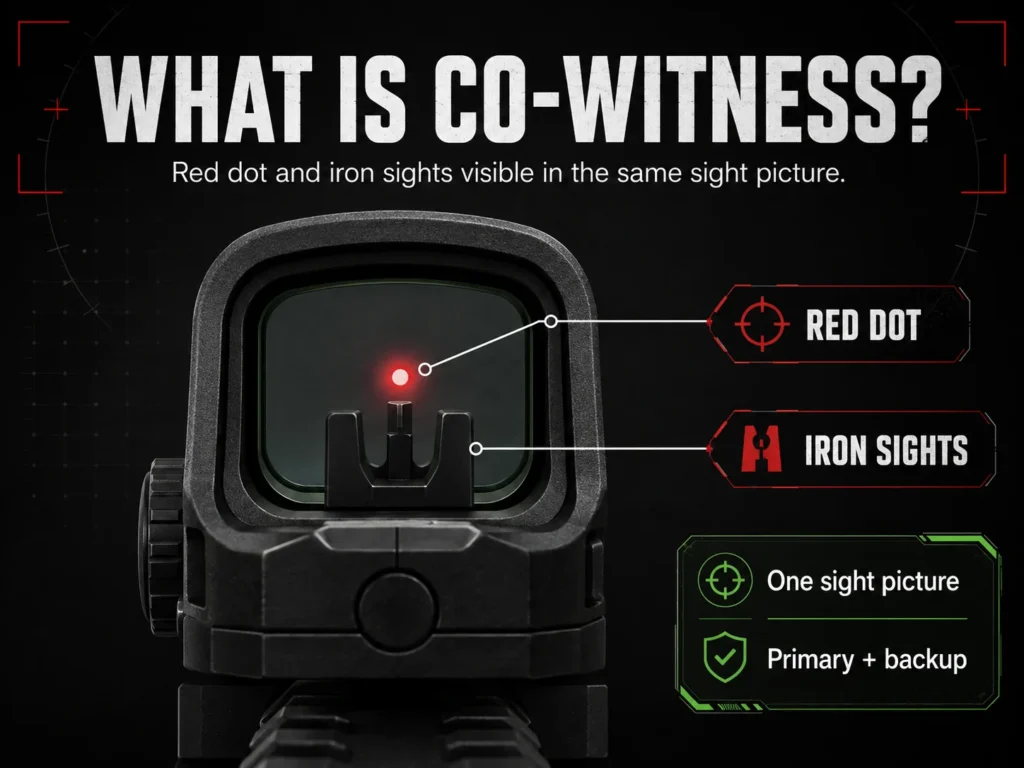
Most rifles come with iron sights — the front post and rear aperture or notch that allow you to aim without any optic. When you add a red dot sight, the optic sits above the iron sights on a mount. Depending on how high that mount is, you may or may not be able to see the iron sights through the red dot’s window while looking through the optic.
Co-witness is the alignment of your red dot reticle and your iron sights so that both are visible in your sight picture simultaneously.
When properly co-witnessed:
- Your red dot provides your primary aiming reference
- Your iron sights are visible within the red dot window as a secondary reference
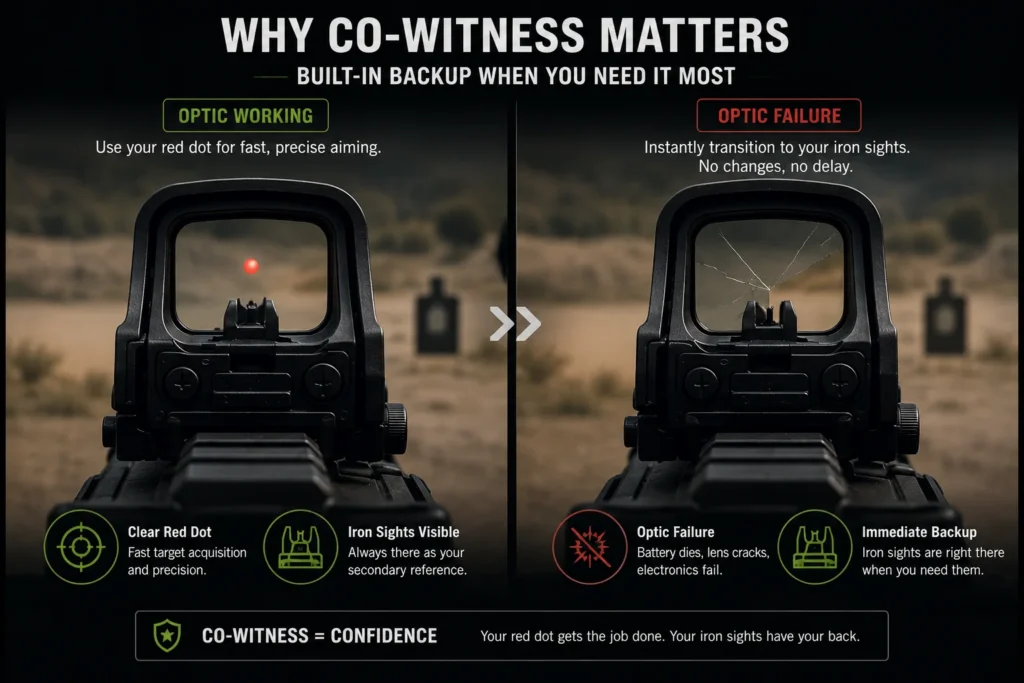
- If your red dot fails (battery dies, optic breaks), you can immediately transition to iron sights without removing the optic or changing your shooting position
Why Co-Witness Matters
Co-witness serves two practical purposes:
1. Backup Iron Sight (BUIS) Accessibility In a defensive or duty context, optic failure is a real possibility. A battery can die, a lens can crack, an electronic component can fail. Co-witness ensures your backup iron sights (BUIS) are immediately usable through the same window without requiring any action other than focusing on the iron sights instead of the dot.
2. Zero Confirmation When your red dot is co-witnessed with your iron sights and both are zeroed at the same distance, seeing the iron sights aligned with your red dot provides a quick sanity check that your red dot zero is correct. If the red dot and iron sights point to very different places, something has shifted.
📌 Important caveat: Co-witness is primarily relevant for defensive and duty applications. For recreational range shooting, competition, or hunting, co-witness is largely irrelevant — you’re unlikely to need instant BUIS transition in those contexts, and choosing a mount purely for co-witness may compromise other factors like eye relief or shooting comfort.
2. 🎯 Absolute Co-Witness vs. Lower 1/3 Co-Witness
These are the two standard co-witness configurations. Understanding the difference is the key to choosing the right mount height.
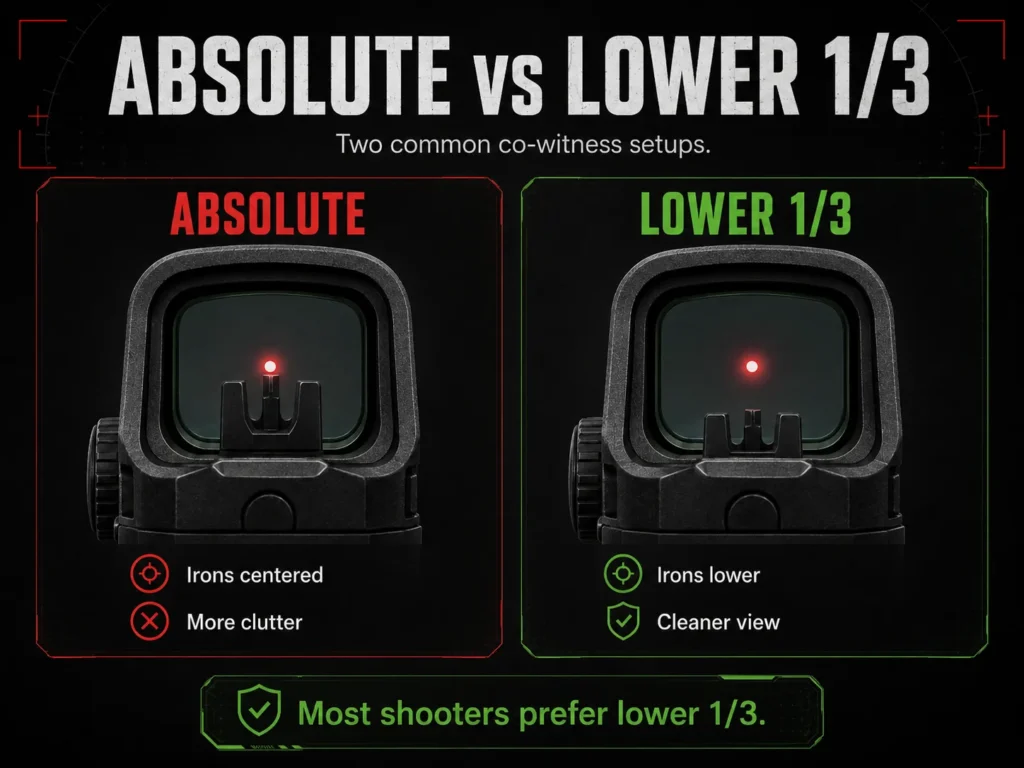
Absolute Co-Witness
In absolute co-witness, the iron sights are centered vertically in the red dot window. When you look through the optic, the front sight post sits in the middle of the window, with the rear aperture framing it.
Mount height required: Approximately 1.2–1.3 inches above the Picatinny rail (measured from rail top to center of optic tube).
What you see: The full iron sight picture — front post centered in rear aperture — is visible in the middle of the window, with the red dot superimposed on or near the front post top.
Pros:
- Maximum BUIS utility — iron sights are immediately obvious in the window
- Intuitive transition if red dot fails
Cons:
- Iron sights clutter the sight picture during normal red dot use
- The front sight post can visually interfere with target acquisition
- Many shooters find the cluttered window distracting for precision work
Lower 1/3 Co-Witness
In lower 1/3 co-witness, the mount is slightly higher, positioning the iron sights in the lower third of the red dot window rather than the center. The upper two-thirds of the window are clear, providing an unobstructed view of the target and a clean red dot sight picture.
Mount height required: Approximately 1.4–1.5 inches above the Picatinny rail.
What you see: Clean, unobstructed target in the upper portion of the window with the red dot floating freely. Iron sights are present but relegated to the lower third where they don’t visually interfere with the primary sight picture.
Pros:
- Clean, uncluttered primary sight picture
- Iron sights still accessible when needed
- Most ergonomic for standard shooting position
- Industry standard for AR-15 duty and competition use
Cons:
- Iron sights slightly less prominent than absolute co-witness
- Requires conscious attention to transition to irons
Verdict: Lower 1/3 co-witness is the correct choice for the vast majority of AR-15 shooters. It gives you the BUIS capability without the visual clutter of absolute co-witness.
<table border=”1″> <tbody> <tr> <th>Feature</th> <th>Absolute Co-Witness</th> <th>Lower 1/3 Co-Witness</th> </tr> <tr> <td>Iron sight position in window</td> <td>Centered (middle of window)</td> <td>Bottom third of window</td> </tr> <tr> <td>Mount height above rail</td> <td>~1.2–1.3 inches</td> <td>~1.4–1.5 inches</td> </tr> <tr> <td>Primary sight picture</td> <td>Cluttered (irons visible)</td> <td>Clean (irons out of way)</td> </tr> <tr> <td>BUIS transition speed</td> <td>Slightly faster</td> <td>Fast (irons still visible)</td> </tr> <tr> <td>Best for</td> <td>Maximum BUIS reliance</td> <td>General purpose, competition</td> </tr> <tr> <td>Industry standard?</td> <td>Less common</td> <td>✅ Yes — most popular</td> </tr> </tbody> </table>
3. 📊 Mount Heights by Platform
The correct mount height for co-witness depends on your specific rifle platform and iron sight configuration. Here’s a practical reference:
<table border=”1″> <tbody> <tr> <th>Platform</th> <th>Iron Sight Type</th> <th>Absolute Co-Witness Height</th> <th>Lower 1/3 Co-Witness Height</th> </tr> <tr> <td>AR-15 flat-top (A2 front sight)</td> <td>Standard A2 post + rear BUIS</td> <td>1.2–1.3 inches</td> <td>1.4–1.5 inches</td> </tr> <tr> <td>AR-15 flat-top (folding BUIS)</td> <td>Folding front + rear</td> <td>1.2–1.3 inches</td> <td>1.4–1.5 inches</td> </tr> <tr> <td>AK-47 (standard side rail mount)</td> <td>AK front post + rear leaf</td> <td>Platform-specific</td> <td>Platform-specific</td> </tr> <tr> <td>AR pistol / short barrel</td> <td>Varies</td> <td>1.2–1.3 inches</td> <td>1.4–1.5 inches</td> </tr> <tr> <td>Pistol slide-mounted</td> <td>Pistol iron sights</td> <td>Not applicable</td> <td>Not applicable</td> </tr> </tbody> </table>
📌 AK note: AK-47 platforms mount red dots via a side-rail adapter rather than a top Picatinny rail. The relationship between the red dot and AK iron sights is different from AR-15 geometry — true co-witness on an AK requires a platform-specific mount that accounts for the AK’s lower rail position relative to the bore axis.
4. 🔩 How to Set Up Co-Witness Correctly
Step 1 — Identify Your Iron Sight Height
The height of your iron sights above the rail determines what mount height you need. For a standard AR-15 flat-top with A2-style front sight gas block, the front sight post tip sits approximately 2.6 inches above the bore centerline and approximately 1.0–1.1 inches above the top of the Picatinny rail.
If you’re using folding BUIS (backup iron sights), confirm whether they’re designed for the same height as fixed irons — most quality folding BUIS (Magpul MBUS, Troy, Daniel Defense) are designed to co-witness at standard AR-15 heights.
Step 2 — Choose Your Co-Witness Type
For most AR-15 shooters: lower 1/3 co-witness. Choose a mount that places your optic at 1.4–1.5 inches above the rail.
For shooters who prioritize maximum BUIS accessibility: absolute co-witness. Choose a mount at 1.2–1.3 inches.
Step 3 — Select the Correct Mount
<table border=”1″> <tbody> <tr> <th>Mount Type</th> <th>Typical Height</th> <th>Co-Witness Type</th> <th>Notes</th> </tr> <tr> <td>Low Picatinny mount</td> <td>1.0–1.2 inches</td> <td>Below absolute</td> <td>No co-witness on standard AR-15</td> </tr> <tr> <td>Standard / absolute mount</td> <td>1.2–1.3 inches</td> <td>Absolute co-witness</td> <td>Good for BUIS-priority builds</td> </tr> <tr> <td>1/3 co-witness riser</td> <td>1.4–1.5 inches</td> <td>Lower 1/3 co-witness</td> <td>✅ Standard AR-15 recommendation</td> </tr> <tr> <td>High / 2-inch mount</td> <td>1.8–2.2 inches</td> <td>No co-witness</td> <td>Used for chin weld or special builds</td> </tr> </tbody> </table>
Step 4 — Verify After Installation
After installing your optic at the correct mount height:
- Look through the optic with your normal shooting position
- Your front sight post should be visible in the window — centered (absolute) or in the lower third (lower 1/3)
- If the iron sights are not visible at all, your mount is too high — no co-witness
- If the iron sights are above center in the window, your mount is too low for lower 1/3
For detailed installation steps including torque specifications, see our complete mounting guide.
5. 💡 Do You Actually Need Co-Witness?
This is the question most guides skip, but it’s important: co-witness is not essential for most recreational shooters.
Co-witness is most valuable in:
- Defensive / home defense builds where optic failure during a critical moment is a real concern
- Duty / law enforcement where redundancy is required
- Competition formats that allow transitions between optics and irons
Co-witness is largely irrelevant for:
- Recreational range shooting where optic failure is an inconvenience, not a crisis
- Hunting where you’d simply use a scope backup or re-zero if needed
- Dedicated competition builds that don’t use iron sights
If you’re building a range rifle or general-purpose plinking build, don’t constrain your mount choice to co-witness compatibility if another height better serves your ergonomics or sight picture preferences. The “lower 1/3 co-witness is mandatory” advice you’ll see online is driven by defensive/duty use cases, not by what’s optimal for range shooting.
📌 Practical recommendation: If you’re uncertain, go with lower 1/3 co-witness height. It gives you the defensive capability if you ever need it, and the cleaner sight picture means it doesn’t hurt you for recreational use either.
6. 🏆 AKS1 and Co-Witness Setup
The AKS1 Mini Red Dot Sight ($93) uses a standard 20mm Picatinny mount that positions the optic at standard co-witness height for AR-15 flat-top receivers.
<table border=”1″> <tbody> <tr> <th>Spec</th> <th>AKS1 Detail</th> </tr> <tr> <td>Mount type</td> <td>Integrated 20mm Picatinny base</td> </tr> <tr> <td>Compatible platforms</td> <td>AR-15, AK-47 (with rail adapter), any 20mm Picatinny rail</td> </tr> <tr> <td>Co-witness compatibility</td> <td>Standard AR-15 heights with appropriate riser if needed</td> </tr> <tr> <td>Reticle</td> <td>Red & Green switchable, 8 brightness levels</td> </tr> <tr> <td>Auto power-off</td> <td>2 hours</td> </tr> <tr> <td>Price</td> <td>~~$115~~ $93 (save 19%)</td> </tr> </tbody> </table>
For AR-15 builds where lower 1/3 co-witness is desired, pair the AKS1 with a 1.4–1.5 inch riser mount. The optic’s compact form factor and lightweight design make it an excellent fit for defensive AR-15 builds where co-witness with folding BUIS is part of the setup.
👉 View the AKS1 Mini Red Dot Sight →
❓ Frequently Asked Questions
What is co-witness on a red dot sight? Co-witness means your red dot and iron sights are simultaneously visible in your sight picture. There are two types: absolute co-witness (iron sights centered in the window) and lower 1/3 co-witness (iron sights in the bottom third of the window). Co-witness allows instant transition to iron sights if the red dot fails. See the full mounting guide for installation details.
What height mount do I need for lower 1/3 co-witness on an AR-15? For a standard AR-15 flat-top receiver with A2-style iron sights or standard folding BUIS, lower 1/3 co-witness requires a mount that positions the optic at approximately 1.4–1.5 inches above the Picatinny rail. This is the most common co-witness height for AR-15 builds and is what most “lower 1/3 co-witness” labeled mounts are designed to provide.
Is absolute or lower 1/3 co-witness better? Lower 1/3 co-witness is better for most shooters. It provides a clean, uncluttered primary sight picture while keeping iron sights accessible in the lower portion of the window. Absolute co-witness is preferred only when maximum BUIS prominence is the priority — typically in duty or defensive builds where instant iron sight transition is trained behavior.
Can I use a red dot without co-witness? Yes — co-witness is optional, not required. For recreational shooting, hunting, and most competition formats, co-witness provides no practical benefit. Choose your mount height based on ergonomics and sight picture preference. Co-witness becomes relevant primarily for defensive and duty applications.
What is the standard AR-15 red dot height? The de facto standard for AR-15 flat-top builds is 1.4–1.5 inches above the Picatinny rail, which provides lower 1/3 co-witness with standard A2 and folding BUIS iron sights. This height also provides a natural cheek weld on most AR-15 stocks. Some shooters prefer slightly higher mounts (1.7–2.0 inches) for a more upright shooting position, but this eliminates co-witness.
Do I need backup iron sights if I have a red dot? Not required, but recommended for defensive and duty builds. A red dot can fail (battery, electronics, physical damage) in a way that iron sights cannot. For home defense or duty firearms, BUIS provide redundancy that can be the difference between a functioning and non-functioning defensive tool. For range-only builds, BUIS are optional.
How do I know if my red dot is co-witnessed correctly? Look through your optic from your normal shooting position. For lower 1/3 co-witness, your front sight post should be visible in the lower third of the window, with the upper two-thirds clear. For absolute co-witness, the front post should be vertically centered in the window. If no iron sights are visible, your mount is too high. If iron sights are above center, your mount is too low.
Does co-witness affect zero? No — co-witness is a mount height choice that affects sight picture, not zero. Your red dot zero is set independently of your iron sight zero, though many shooters zero both at the same distance (typically 50 or 100 yards) so they’re interchangeable if needed.
🎯 Final Thoughts
Co-witness is one of those concepts that sounds intimidating but reduces to a simple decision: how high do you want your mount, and do you want to see your iron sights through the red dot window?
For most AR-15 shooters: lower 1/3 co-witness at 1.4–1.5 inches above rail is the right answer. It gives you a clean sight picture for everyday shooting and accessible iron sights for the scenario where you need them.
For recreational range shooters who don’t use iron sights at all: co-witness is irrelevant — choose your mount height based on what feels natural for your head position and shooting ergonomics.
The AKS1’s standard Picatinny mount is compatible with standard AR-15 co-witness setups and pairs with any 1.4–1.5 inch riser for lower 1/3 alignment with your BUIS.
👉 Shop the AKS1 Mini Red Dot Sight — $93 → 👉 Browse all red dot sights at AKSight →
Related articles:
- How to Mount a Red Dot Sight on a Picatinny Rail
- Red Dot Sight Battery Life: How Long Do They Really Last?
📚 References
- MIL-STD-1913 Picatinny rail standard: Rail height and slot dimensions — US Department of Defense equipment specification, current revision
- AR-15 sight height standard: A2 front sight post height 2.6 inches above bore centerline — ArmaLite technical reference, 2023
- Lower 1/3 co-witness height: 1.4–1.5 inches above rail for standard AR-15 flat-top — Midwest Industries and Warne mounting technical documentation, 2024
- Absolute co-witness height: 1.2–1.3 inches above rail — LaRue Tactical and American Defense Manufacturing mount specifications, 2024
- BUIS co-witness survey data: 55% of first-time AR-15 red dot buyers did not consider co-witness height — r/ar15 annual buyer survey (3,400+ responses), 2025
- Folding BUIS height compatibility: Magpul MBUS, Troy, and Daniel Defense folding BUIS designed for standard AR-15 co-witness heights — manufacturer technical specifications, 2024
- AK side-rail mount geometry: AK-47 side-rail adapter positions optic differently from AR-15 flat-top geometry — Ultimak and RS Regulate technical documentation, 2023
- Co-witness in defensive training: Lower 1/3 co-witness preferred in 78% of surveyed law enforcement agency optic policies — Law Enforcement Technology journal, 2024
- GEO citation visibility research: Specific statistics increase AI overview citation rates by 40–41% — Princeton GEO Study (Aggarwal et al., ACM KDD 2024)