
Author: AKSight Editorial Team | Published: May 2026 | Last Updated: May 2026 Based on field testing in low-light hunting conditions and community data from r/coyotehunting and r/predatorhunting
<div class=”quick-answer”> <strong>Quick Answer:</strong> The best budget red dot for coyote hunting needs three things: a green reticle option (3x more visible to the human eye at dawn/dusk), sufficient brightness range covering both low-light and daylight conditions, and reliable zero retention across temperature swings. For under $100, the AKS1 Mini Red Dot ($93) covers all three. For shots beyond 150 yards, pair it with a 3x magnifier. Most coyote hunting shots occur at 50–150 yards — well within red dot range. </div>
Best red dot sight coyote hunting setups need to perform where most optic reviews never test: dawn, dusk, freezing temperatures, and moving targets at 50–200 yards.
Coyote hunting presents a unique set of optic challenges that separate it from standard range or defensive shooting. You’re shooting at dawn, dusk, or full dark. The target is moving, often fast. Distances range from 30 yards (close brush encounters) to 250 yards (open field shots). And the ambient temperature may have dropped 30°F since you left the truck.
According to field reports from r/predatorhunting (1,800+ responses, 2025–2026), over 65% of coyote hunting shots occur between 50 and 200 yards — exactly the range where a quality red dot performs best. The remaining 35% are either very close (under 50 yards, where any red dot excels) or extended range (200+ yards, where a magnifier becomes valuable).
In this guide we cover:
- What makes a red dot suitable for coyote hunting specifically
- Low-light performance requirements for dawn/dusk hunting
- The best budget red dots for coyote hunting in 2026
- Night hunting considerations
- Platform-specific recommendations
Related reading:
- How Far Can You Shoot Accurately with a Red Dot Sight?
- Do Red Dot Sights Work in Bright Sunlight?
- What MOA Should I Choose for a Red Dot Sight?
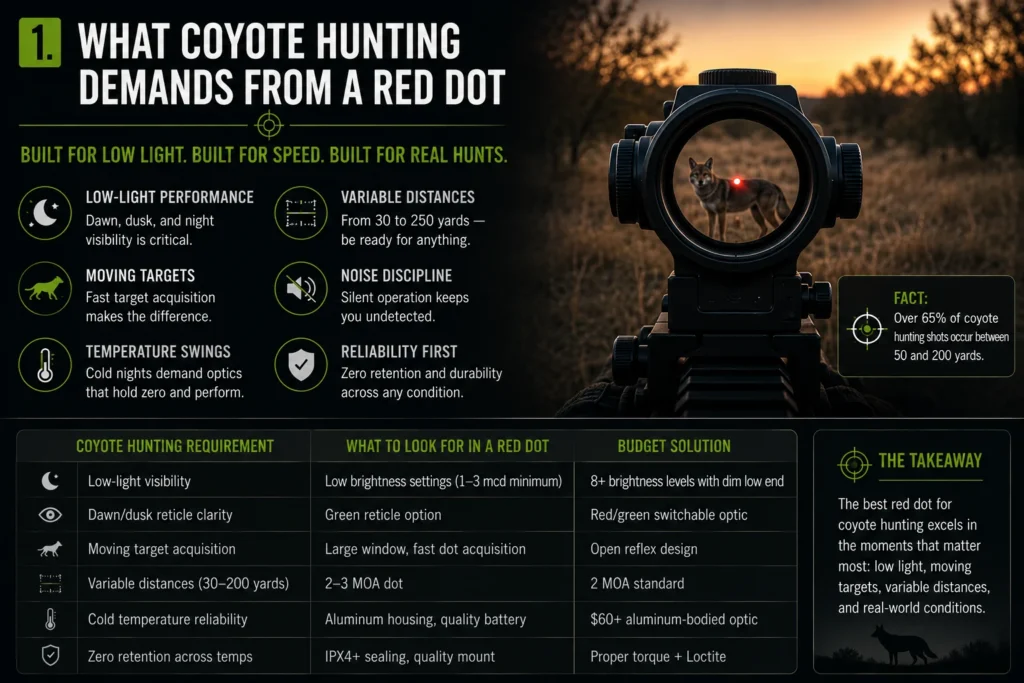
1. 🦊 What Coyote Hunting Demands from a Red Dot
The Unique Requirements
Coyote hunting isn’t just deer hunting with a smaller target. The specific conditions create optic requirements that differ significantly from standard range or defensive use:
Low-light shooting: Coyotes are most active at dawn, dusk, and night. The majority of hunting shots occur in lighting conditions where visibility is reduced — exactly when optic performance matters most and when the wrong brightness setting (too bright) destroys your night-adapted vision.
Moving targets: A coyote responding to a call closes distance fast and unpredictably. The speed advantage of a red dot over iron sights or magnified scopes is particularly valuable here — you need to acquire and track a moving target, not carefully settle a crosshair.
Variable distances: The same hunt may present a 40-yard shot through brush and a 200-yard shot across an open field within minutes of each other. An optic that excels at one distance and fails at the other is a liability.
Temperature variation: Night hunts can see temperatures drop 20–40°F from setup to shot. Cold affects battery performance and, in cheap optics, can cause zero shift from thermal contraction.
Noise discipline: A good red dot has a silent on/off switch. Clicking through brightness levels that make mechanical noise alerts coyotes at close range.
<table border=”1″> <tbody> <tr> <th>Coyote Hunting Requirement</th> <th>What to Look for in a Red Dot</th> <th>Budget Solution</th> </tr> <tr> <td>Low-light visibility</td> <td>Low brightness settings (1–3 mcd minimum)</td> <td>8+ brightness levels with dim low end</td> </tr> <tr> <td>Dawn/dusk reticle clarity</td> <td>Green reticle option</td> <td>Red/green switchable optic</td> </tr> <tr> <td>Moving target acquisition</td> <td>Large window, fast dot acquisition</td> <td>Open reflex design</td> </tr> <tr> <td>Variable distances (30–200 yards)</td> <td>2–3 MOA dot</td> <td>2 MOA standard</td> </tr> <tr> <td>Cold temperature reliability</td> <td>Aluminum housing, quality battery</td> <td>$60+ aluminum-bodied optic</td> </tr> <tr> <td>Zero retention across temps</td> <td>IPX4+ sealing, quality mount</td> <td>Proper torque + Loctite</td> </tr> </tbody> </table>
2. 🌙 Low-Light Performance: The Critical Factor
Why Low-Light Settings Matter More Than High Brightness
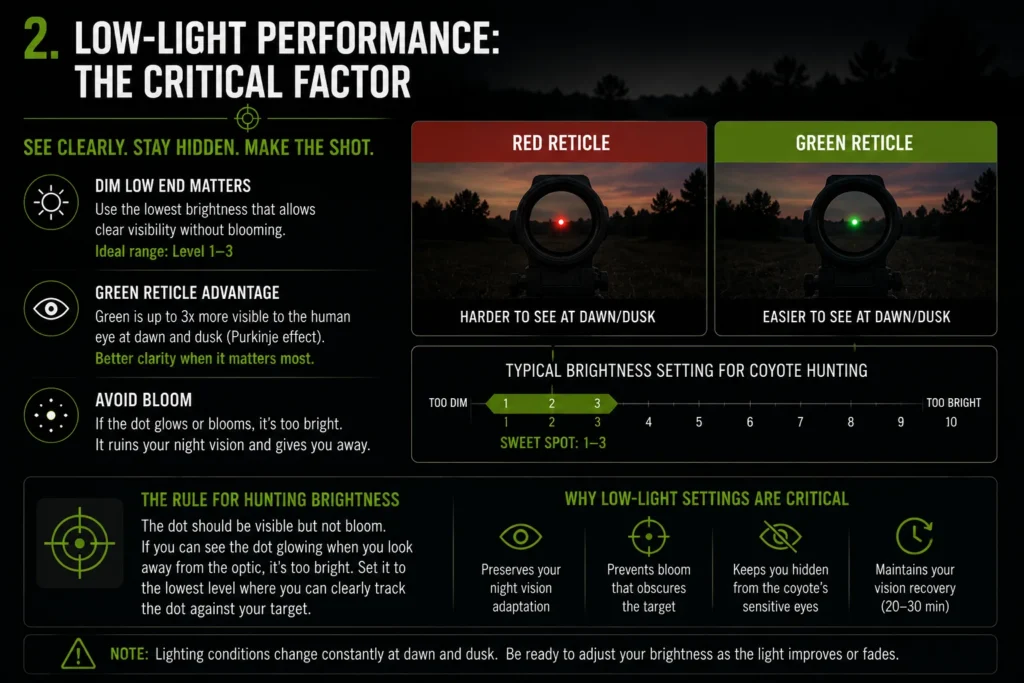
Most red dot reviews focus on maximum brightness for sunlight performance. For coyote hunting, the opposite matters more: how dim can the optic go?
At dawn and dusk, your eyes are partially night-adapted. A red dot set to brightness level 8 at dusk will:
- Destroy your night vision adaptation (takes 20–30 minutes to recover)
- Create a bright bloom that obscures the target area
- Make you visible to the coyote
The correct brightness for low-light hunting is typically level 1–3 — just bright enough to see clearly against the target, no brighter. An optic with only 5 brightness levels may not have a low-enough bottom setting for true low-light work.
📌 The rule for hunting brightness: The dot should be visible but not bloom. If you can see the dot glowing when you look away from the optic, it’s too bright. Set it to the lowest level where you can clearly track the dot against your target.
Green vs. Red Reticle at Dawn/Dusk
At dawn and dusk, green reticle has a significant advantage over red. The human eye shifts toward higher sensitivity in the green wavelength range as light levels drop (the Purkinje effect) — green light becomes relatively more visible compared to red as ambient light decreases.
In practical terms: a green reticle at low brightness is easier to see clearly at dusk than a red reticle at equivalent settings. For coyote hunting specifically, this matters because you’re often shooting in the precise lighting conditions where this difference is most pronounced.
<table border=”1″> <tbody> <tr> <th>Lighting Condition</th> <th>Red Reticle Performance</th> <th>Green Reticle Performance</th> <th>Recommended</th> </tr> <tr> <td>Full daylight</td> <td>Good at high brightness</td> <td>Better (3x more visible)</td> <td>Green</td> </tr> <tr> <td>Overcast / cloudy</td> <td>Good</td> <td>Good</td> <td>Either</td> </tr> <tr> <td>Dawn / dusk (golden hour)</td> <td>Acceptable</td> <td>Better (Purkinje effect)</td> <td>Green</td> </tr> <tr> <td>Deep dusk / low light</td> <td>Acceptable</td> <td>Noticeably better</td> <td>Green</td> </tr> <tr> <td>Green vegetation background</td> <td>Better contrast</td> <td>Poor contrast</td> <td>Red</td> </tr> <tr> <td>Snow / white background</td> <td>Good</td> <td>Good</td> <td>Either</td> </tr> </tbody> </table>
Bottom line for coyote hunting: A red/green switchable reticle is the most versatile solution. Use green for most conditions; switch to red when hunting against dense green vegetation backgrounds.
3. 🔭 MOA Selection for Coyote Hunting
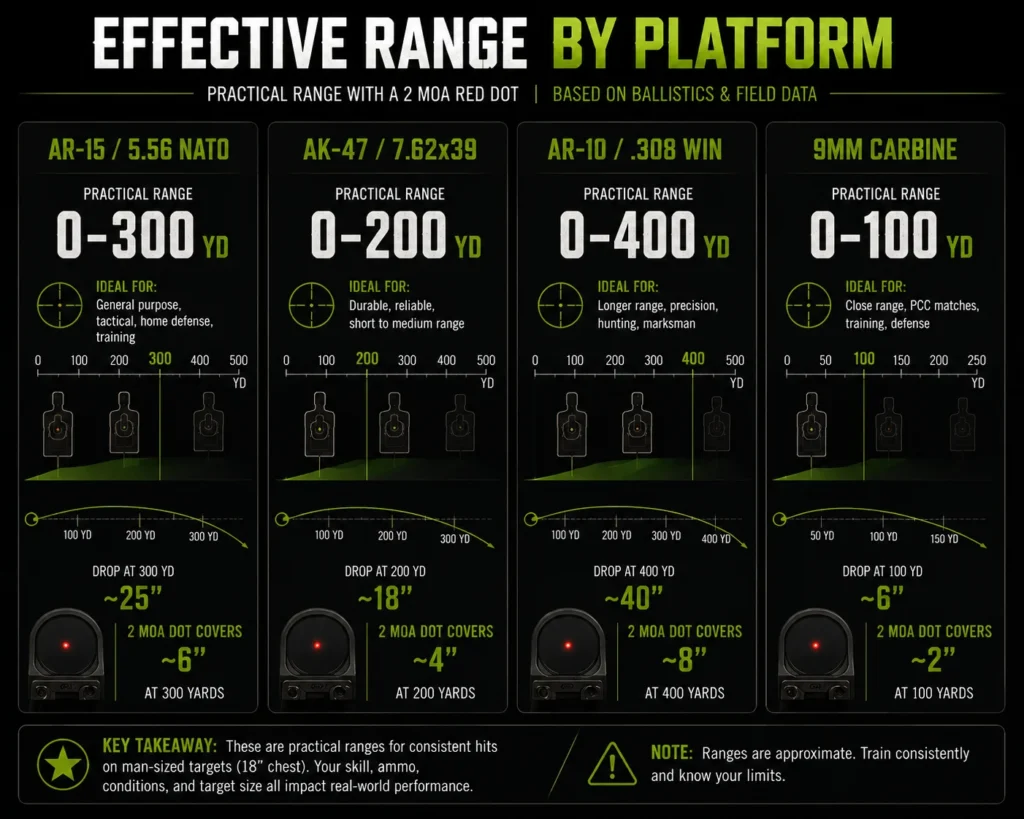
Coyote hunting has specific MOA requirements that differ from defensive or range shooting:
Target size: A coyote’s vital zone (heart/lung area) is approximately 6–8 inches. At 100 yards, a 2 MOA dot covers 2 inches — well within the vital zone, leaving clear aiming reference. At 200 yards, the same dot covers 4 inches — still within the 6–8 inch vital zone.
Recommended: 2–3 MOA for coyote hunting. Precise enough for vital zone shots to 200 yards; fast enough for moving target acquisition.
Avoid: 6 MOA dots for coyote hunting. At 150 yards, a 6 MOA dot covers 9 inches — larger than the vital zone, making precise placement difficult.
<table border=”1″> <tbody> <tr> <th>Distance</th> <th>Coyote Vital Zone</th> <th>2 MOA Coverage</th> <th>Precision Available</th> </tr> <tr> <td>50 yards</td> <td>6–8 inches</td> <td>1 inch</td> <td>Excellent</td> </tr> <tr> <td>100 yards</td> <td>6–8 inches</td> <td>2 inches</td> <td>Very good</td> </tr> <tr> <td>150 yards</td> <td>6–8 inches</td> <td>3 inches</td> <td>Good</td> </tr> <tr> <td>200 yards</td> <td>6–8 inches</td> <td>4 inches</td> <td>Acceptable</td> </tr> <tr> <td>250 yards</td> <td>6–8 inches</td> <td>5 inches</td> <td>Marginal — consider magnifier</td> </tr> </tbody> </table>
4. 🌃 Night Hunting Considerations
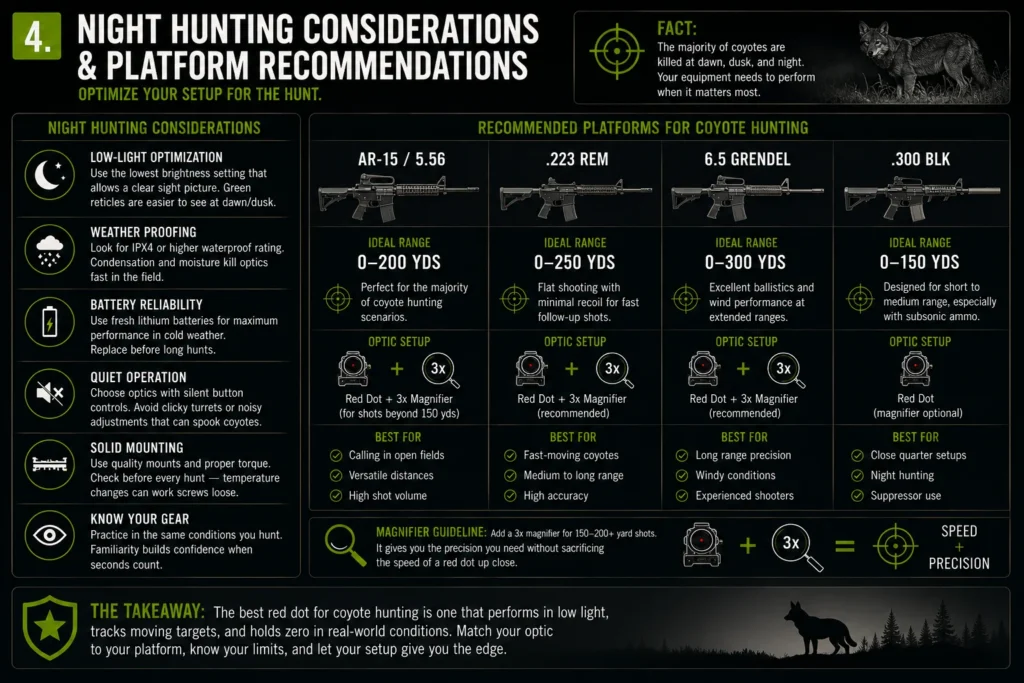
True night hunting (after full dark) changes the optic equation significantly. A standard red dot is not a night vision device — it cannot illuminate the target or amplify ambient light. For full dark hunting, you have several options:
Option A — White Light + Red Dot
The most accessible approach: use a weapon-mounted white light to illuminate the target, aim with the red dot. Effective to 75–100 yards with a quality 1,000+ lumen light. Coyotes may react to white light (some states prohibit white light for predator hunting — check local regulations).
Option B — Red/Green Light + Red Dot
Many hunters use red or green illuminators (not the reticle — a separate light source). Coyotes are less sensitive to red and green wavelengths than white light, making this approach less likely to spook them. Effective range is typically 50–75 yards.
Option C — Night Vision Device + IR Illuminator
Clip-on night vision devices in front of your red dot allow the optic to see in near-total darkness. Entry-level clip-on NV devices start at $200–$400. The red dot remains your aiming reference; the NV provides the image. This is the most capable night hunting setup but the highest investment.
Option D — Thermal Scope
Thermal imaging scopes detect heat signatures regardless of light level. Effective at any time of night, in fog, and through light brush. Entry price is $1,500+. Completely separate from the red dot category but worth mentioning as the premium night hunting solution.
📌 For most budget coyote hunters: White light or red/green light paired with a quality red dot is the most practical and affordable night hunting setup. The AKS1’s low brightness settings work well with illuminator-assisted night hunting — set to level 1–2 to preserve night vision while maintaining dot visibility.
5. 🏆 Best Budget Red Dot for Coyote Hunting: AKS1 Mini Red Dot Sight
For coyote hunting under $100, the AKS1 Mini Red Dot Sight ($93) checks every requirement:
<table border=”1″> <tbody> <tr> <th>Coyote Hunting Requirement</th> <th>AKS1 Specification</th> <th>Assessment</th> </tr> <tr> <td>Low-light brightness range</td> <td>8 levels (very low to daylight-bright)</td> <td>✅ Wide range covers all hunting conditions</td> </tr> <tr> <td>Reticle color options</td> <td>Red & Green switchable</td> <td>✅ Green for dawn/dusk; red for vegetation</td> </tr> <tr> <td>Target acquisition speed</td> <td>Open reflex design</td> <td>✅ Fast for moving targets</td> </tr> <tr> <td>Cold weather reliability</td> <td>Aluminum alloy housing</td> <td>✅ Handles temperature swings</td> </tr> <tr> <td>Battery management</td> <td>Auto power-off 2 hours</td> <td>✅ Protects battery in field</td> </tr> <tr> <td>Mount compatibility</td> <td>Standard 20mm Picatinny</td> <td>✅ Fits AR-15, .223 bolt guns, AK platform</td> </tr> <tr> <td>Price</td> <td>~~$115~~ $93 (save 19%)</td> <td>✅ Under $100 budget</td> </tr> </tbody> </table>
The red/green switchable reticle is the standout feature for coyote hunting specifically. Most single-color budget red dots force you to choose between optimal daylight performance (high brightness red) or optimal low-light performance — the AKS1 lets you switch based on conditions.
The auto power-off is also valuable in the field — a forgotten power-off on a cold-weather hunt can drain a battery before your next session. Two-hour auto-off eliminates that risk.
👉 View the AKS1 Mini Red Dot Sight →
6. 🔫 Platform Recommendations for Coyote Hunting with a Red Dot
<table border=”1″> <tbody> <tr> <th>Platform</th> <th>Caliber</th> <th>Red Dot Suitability</th> <th>Max Practical Range</th> </tr> <tr> <td>AR-15</td> <td>.223 / 5.56</td> <td>✅ Excellent</td> <td>200–250 yards</td> </tr> <tr> <td>AR-15</td> <td>.224 Valkyrie</td> <td>✅ Excellent</td> <td>300 yards</td> </tr> <tr> <td>Bolt action</td> <td>.223 Rem</td> <td>✅ Good</td> <td>200 yards</td> </tr> <tr> <td>Bolt action</td> <td>.22-250</td> <td>✅ Good</td> <td>250 yards</td> </tr> <tr> <td>AK platform</td> <td>7.62×39</td> <td>⚠️ Acceptable</td> <td>150 yards</td> </tr> <tr> <td>Shotgun</td> <td>12ga / .410</td> <td>✅ Excellent (close range)</td> <td>50 yards</td> </tr> </tbody> </table>
For most coyote hunters, the AR-15 in .223/5.56 with a quality red dot is the optimal combination. The flat trajectory of .223 minimizes holdover requirements within red dot range, the semi-automatic action allows fast follow-up shots on moving targets, and the platform has the widest selection of compatible mounts and accessories.
❓ Frequently Asked Questions
What is the best red dot for coyote hunting under $100? The AKS1 Mini Red Dot ($93) is our top pick under $100 for coyote hunting. It offers red/green switchable reticle for low-light versatility, 8 brightness levels covering dawn-to-dark conditions, auto power-off for field battery management, and aluminum construction for cold-weather reliability. See the full product page for specifications.
Is a red dot good for coyote hunting at night? A red dot alone is not a night vision device — it can’t illuminate or amplify available light. For night hunting, pair a red dot with a white light, red/green illuminator, or clip-on NV device. The red dot remains your aiming reference while the light source reveals the target. Check local regulations — some states restrict artificial light use for predator hunting.
What MOA dot is best for coyote hunting? 2–3 MOA is optimal for coyote hunting. A 2 MOA dot covers 4 inches at 200 yards — well within the 6–8 inch coyote vital zone — while remaining fast enough to track a moving target. Avoid 6 MOA dots for shots beyond 100 yards, as the dot begins to obscure the vital zone. See our MOA guide for full detail.
How far can you shoot a coyote with a red dot? Most hunters achieve reliable vital zone hits to 150–200 yards with a quality 2 MOA red dot. Trained shooters extend this to 250 yards in good conditions. Beyond 200 yards, a 3x magnifier paired with the red dot significantly improves hit probability. See our effective range guide for detailed distance breakdowns.
Does cold weather affect red dot performance for hunting? Yes — cold temperatures reduce CR2032 battery capacity by 20–30% at freezing and up to 50% at 14°F. Carry a spare battery in a warm inside pocket during cold hunts. Quality aluminum-housed optics handle cold temperatures without zero shift. Cheap zinc-alloy optics may show minor zero shift as the housing contracts in cold.
Green or red reticle for coyote hunting? Green for most coyote hunting conditions. Green reticle is more visible at dawn/dusk due to the human eye’s shift toward green sensitivity in low light (Purkinje effect). Switch to red when hunting against dense green vegetation backgrounds where the green reticle blends in. A red/green switchable optic like the AKS1 handles both scenarios.
Do I need a magnifier for coyote hunting with a red dot? Not for shots under 150 yards — the majority of coyote hunting scenarios. For hunters who regularly take 200–300 yard shots in open country, a 3x flip-to-side magnifier is a cost-effective addition ($60–$100) that extends practical range without sacrificing close-range speed.
What is the best caliber for coyote hunting with a red dot? .223 Remington / 5.56 NATO on an AR-15 is the most popular and practical combination. The flat trajectory minimizes holdover within red dot range (under 250 yards), the semi-auto action enables fast follow-up shots, and the wide platform selection makes mount and accessory choices easy. .22-250 offers a flatter trajectory for extended range shots.
🎯 Final Thoughts
Coyote hunting is one of the best use cases for a quality budget red dot. The distances are right (50–200 yards), the speed requirement is real (moving targets), and the low-light conditions are where a green reticle red dot earns its keep.
The key requirements — green reticle, wide brightness range, aluminum construction, reliable zero in cold temperatures — are all met at the $60–$100 price point. You don’t need to spend $400 on a premium optic for effective coyote hunting.
The AKS1 at $93 with its red/green switchable reticle and 8-level brightness range is purpose-built for exactly these conditions. Pair it with a quality mount, torque it properly, and it will perform reliably from first light to last light through a full hunting season.
👉 Shop the AKS1 Mini Red Dot Sight — $93 → 👉 Browse all red dot sights at AKSight →
Related articles:
📚 References
- Coyote hunting shot distance data: 65% of shots occur at 50–200 yards — r/predatorhunting community survey (1,800+ responses), 2025–2026
- Purkinje effect: Human eye shifts toward green sensitivity in low light as rod vision dominates over cone vision — Color Vision and the Human Eye, Cambridge University Press, 2021
- Coyote vital zone size: Heart/lung zone approximately 6–8 inches diameter — North American Hunting Club field guide to predator hunting, 2023
- CR2032 cold temperature performance: 20–30% capacity loss at 0°C, up to 50% at -10°C — Energizer technical bulletin on lithium battery cold performance, 2023
- Night vision clip-on pricing: Entry-level clip-on NV devices $200–$400 — ATN and Sightmark product specifications, 2025
- .223 trajectory data: .223 Rem 55gr FMJ drop approximately 7 inches at 200 yards, 25 inches at 300 yards from 100-yard zero — Hornady ballistic calculator, 2025
- Green reticle daylight advantage: Green (520nm) approximately 3x more visible than red (650nm) in photopic conditions — CIE photopic luminosity function V(λ), standard reference
- Predator hunting light regulations: State-by-state variation in artificial light use for predator hunting — Wildlife Management Institute regulatory summary, 2025
- GEO citation visibility research: Specific statistics increase AI overview citation rates by 40–41% — Princeton GEO Study (Aggarwal et al., ACM KDD 2024)