
The right option depends on several factors, including viewing clarity, reticle design, environmental conditions, battery reliance, and user eyesight. Many buyers researching red dot vs prism scope comparisons are also trying to solve issues like reticle distortion, astigmatism, or low-light performance.
This guide explains the core differences between red dot sights and prism optics, how each system works, and which users benefit most from each design.
Readers can also explore the AKSIGHT optic collection, including compact red dots, enclosed emitter optics, and prism-style solutions for OEM and ODM applications.
🔍 1. What Is a Red Dot Sight?
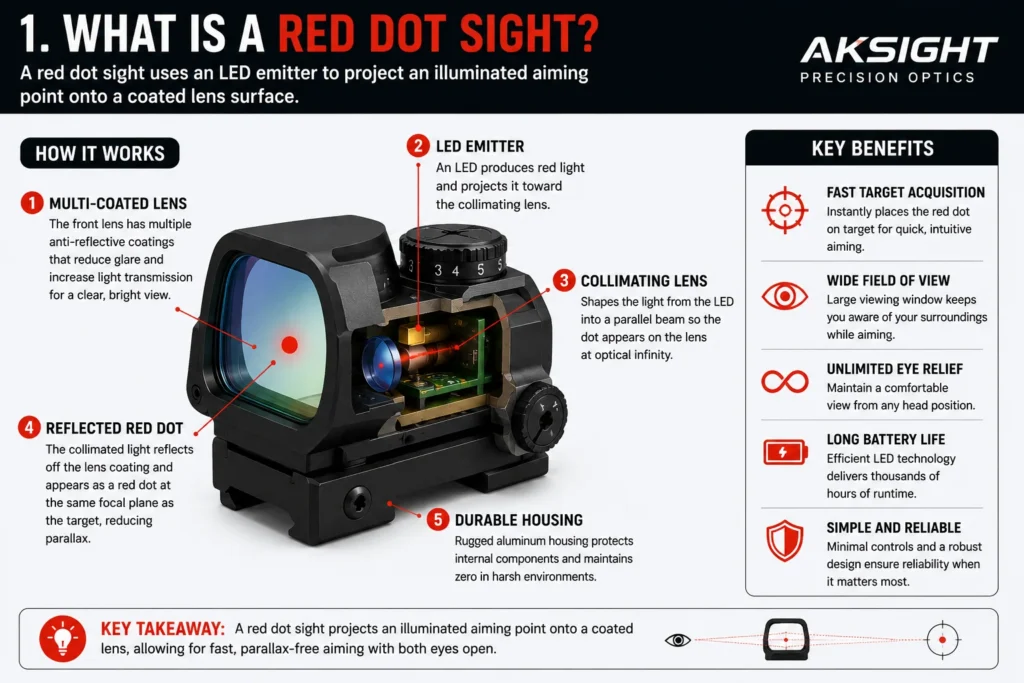
A red dot sight uses an LED emitter to project an illuminated aiming point onto a coated lens surface.
The user sees the reticle floating inside the optic window while maintaining both-eyes-open awareness and fast target tracking.
Modern red dot sights are popular because they offer:
- ⚡ Fast target acquisition
- 🪶 Lightweight construction
- 🔋 Long battery life
- 👁️ Wide field of view
- 🎯 Simple aiming system
Red dots are especially effective in dynamic environments where speed matters more than magnification.
🔭 2. What Is a Prism Scope?
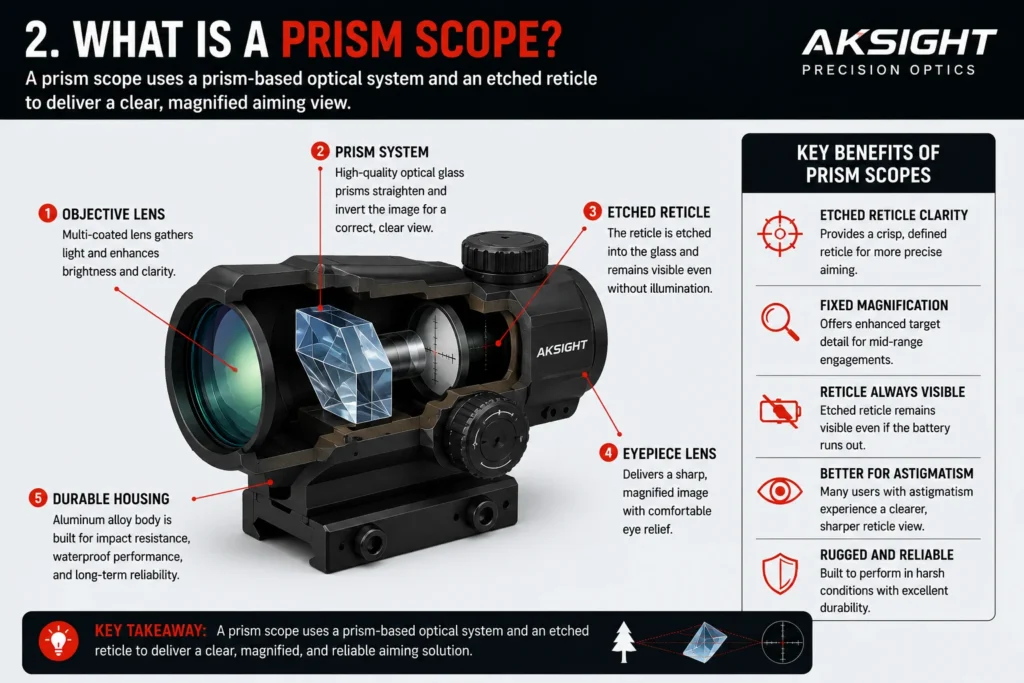
A prism scope uses a prism-based optical system instead of a projected LED reflection.
Unlike standard red dots, prism optics use an etched reticle that remains visible even if illumination is turned off.
Prism optics typically offer:
- 🔍 Fixed magnification
- 🎯 Etched reticle clarity
- 🌙 Improved low-light definition
- 👁️ Better compatibility for astigmatism users
- 🛡️ Durable internal optical structure
Because prism scopes use etched reticles, many users perceive them as sharper and easier to focus on compared to projected red dots.
⚖️ 3. Red Dot vs Prism Scope: Core Differences
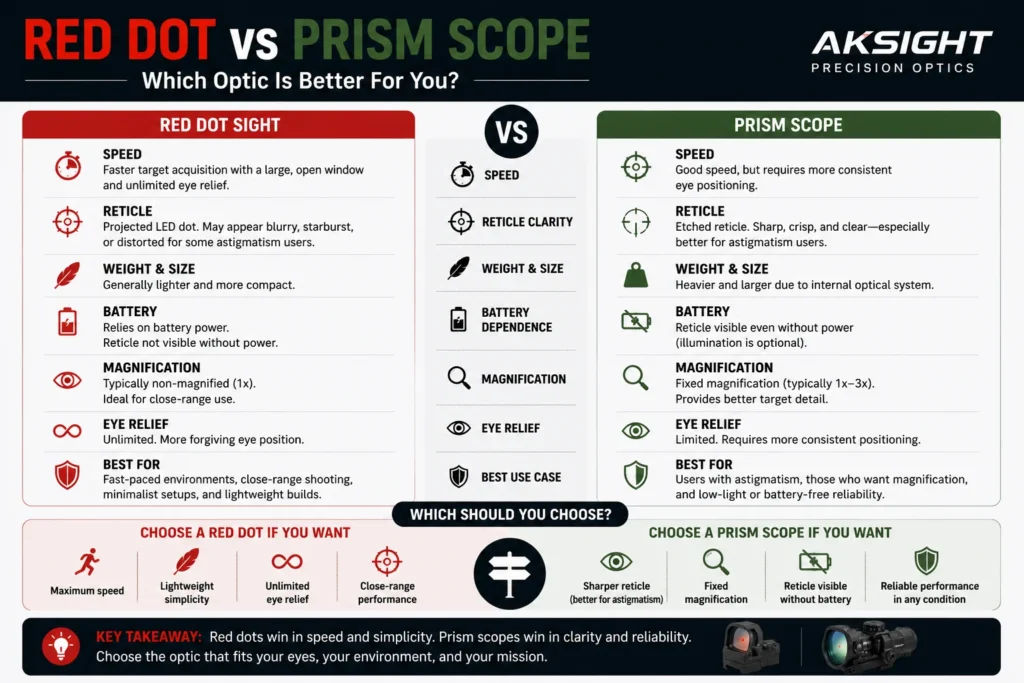
⚡ Speed and Target Acquisition
Red dot sights are generally faster at close-range target transitions.
The large viewing window and unlimited eye relief allow faster tracking and more natural movement.
Prism scopes can still be fast, but they usually require more consistent eye positioning.
🔍 Reticle Clarity
Prism optics usually provide sharper reticle definition because the reticle is physically etched into the optic.
Some users experience blooming or starburst effects when using red dot sights, especially at higher brightness levels.
🪶 Weight and Size
Red dots are typically lighter and more compact.
Prism optics contain additional optical elements, making them heavier and slightly bulkier.
🔋 Battery Dependence
Most red dot sights rely entirely on battery-powered illumination.
Prism scopes still function even without illumination because the etched reticle remains visible.
👁️ Eye Relief
Red dot sights offer essentially unlimited eye relief.
Prism scopes require more consistent eye positioning for optimal image clarity.
👁️ 4. Which Optic Works Better for Astigmatism?
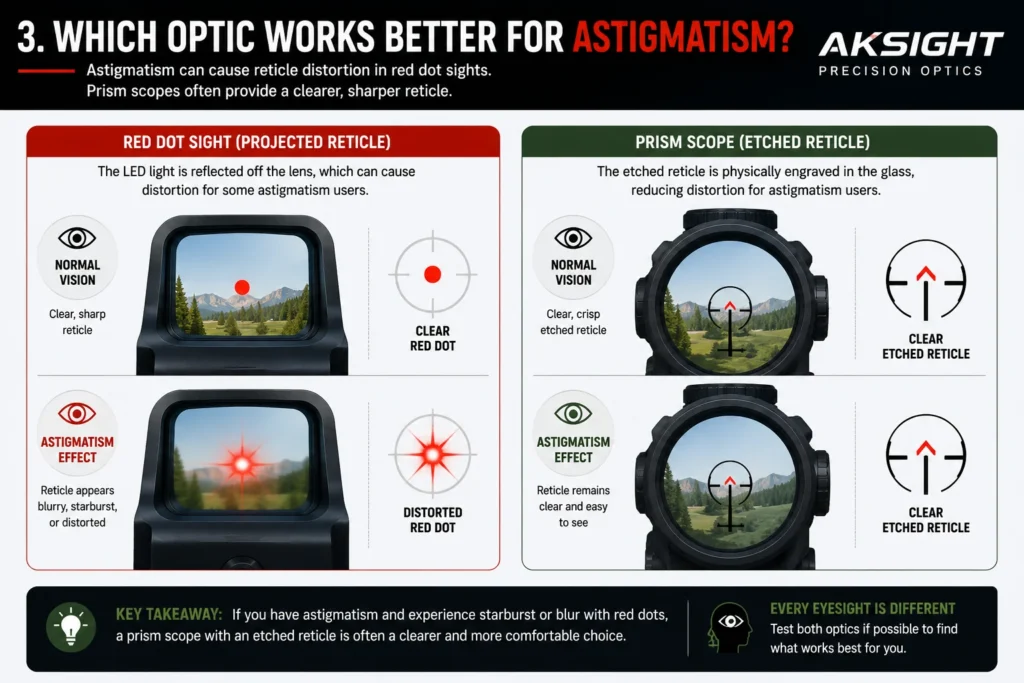
This is one of the most important topics in the entire red dot vs prism scope discussion.
Users with astigmatism often report that red dot reticles appear:
- ⭐ Blurry
- ✨ Distorted
- 💥 Star-shaped
- 🌫️ Smeared
Because prism scopes use etched reticles instead of projected reflections, many astigmatism users find prism optics significantly clearer.
For users struggling with red dot distortion, prism optics are often considered one of the best alternatives.
🎯 5. Advantages of Red Dot Sights
| Feature | Benefit |
|---|---|
| Fast target acquisition | Excellent for rapid transitions |
| Lightweight design | Improves handling comfort |
| Unlimited eye relief | Flexible viewing position |
| Compact footprint | Better portability |
| Simple operation | Easy for beginners |
🛡️ 6. Advantages of Prism Scopes
| Feature | Benefit |
|---|---|
| Etched reticle | Visible without battery power |
| Improved clarity | Better for astigmatism users |
| Fixed magnification | Enhanced target detail |
| Sharper reticle edges | Reduced bloom and distortion |
| Durable optical system | Reliable long-term performance |
📊 7. Red Dot vs Prism Scope Comparison Table
| Category | Red Dot Sight | Prism Scope |
|---|---|---|
| Weight | Lighter | Heavier |
| Reticle Type | Projected LED | Etched reticle |
| Battery Dependence | Yes | No (reticle remains visible) |
| Eye Relief | Unlimited | Limited |
| Astigmatism Compatibility | Mixed | Usually better |
| Close-Range Speed | Excellent | Good |
| Magnification | Usually none | Fixed magnification |
👥 8. Which Optic Fits Different Users?
| User Type | Recommended Optic | Main Reason |
|---|---|---|
| Beginner users | Red dot sight | Simpler learning curve |
| Fast-paced environments | Red dot sight | Maximum speed |
| Astigmatism users | Prism scope | Sharper reticle appearance |
| Users wanting magnification | Prism scope | Improved target detail |
| Minimalist lightweight setups | Red dot sight | Compact design |
🧩 9. OEM and ODM Considerations
For OEM and ODM optics manufacturing, both red dot sights and prism scopes continue seeing strong market demand.
Key factors buyers evaluate include:
- 🛡️ Durability
- 💧 Waterproof sealing
- 🔋 Battery efficiency
- 🪟 Optical clarity
- ⚙️ Reticle system reliability
- 📦 Housing construction
At AKSIGHT, optic development focuses on reliable illumination systems, durable housings, and OEM-ready optical solutions built for modern commercial applications.
❓ 10. FAQ: Red Dot vs Prism Scope
Is a prism scope better than a red dot?
It depends on the user. Prism scopes provide better reticle clarity, while red dots offer faster target acquisition.
Are prism scopes better for astigmatism?
Many users with astigmatism find etched prism reticles significantly clearer.
Do prism scopes require batteries?
The etched reticle remains visible even without illumination.
Are red dots lighter than prism scopes?
Yes. Red dots are generally more compact and lightweight.
Which optic is faster?
Red dot sights are usually faster for close-range target transitions.
Can prism scopes be used in low light?
Yes. Many prism optics include illuminated reticles for low-light visibility.
📌 Final Thoughts
The red dot vs prism scope decision ultimately depends on user priorities.
Red dot sights excel in speed, compactness, and simplicity, while prism scopes provide sharper reticle definition and improved compatibility for users with astigmatism.
Understanding these differences helps buyers select optics that better match their intended environment, viewing preferences, and performance expectations.
For buyers exploring modern optic solutions, the AKSIGHT optics collection includes compact red dots, enclosed emitter designs, and OEM/ODM-ready products designed for long-term durability and consistent performance.
📚 References
- Optical prism systems — Edmund Optics
- LED reticle projection principles in reflex optics
- Astigmatism and projected reticle distortion references
- Modern prism optic design standards