
This guide breaks down the real pros, trade-offs, and use cases so you can choose the right red dot for your setup and environment.
🔍 Open Emitter vs Enclosed Emitter Red Dot: Why It Matters
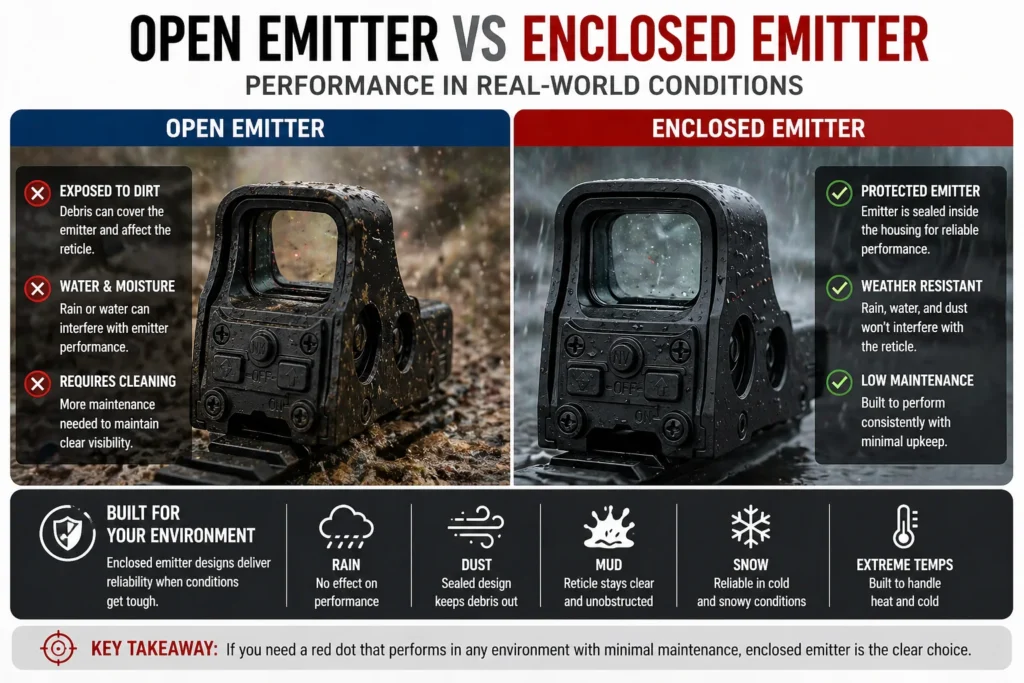
The core difference in an open emitter vs enclosed emitter red dot comes down to how the emitter—the component projecting the reticle—is protected.
Open emitter designs expose the emitter, while enclosed systems seal it inside a tube or housing. That small design difference has a big impact on reliability.
For users prioritizing lightweight builds and wide viewing windows, open emitters are common. For those needing maximum durability and environmental resistance, enclosed emitters are becoming the standard.
For a deeper understanding of optical systems, see this optics overview.
🔭 Types of Red Dot Designs
🔓 Open Emitter Red Dot
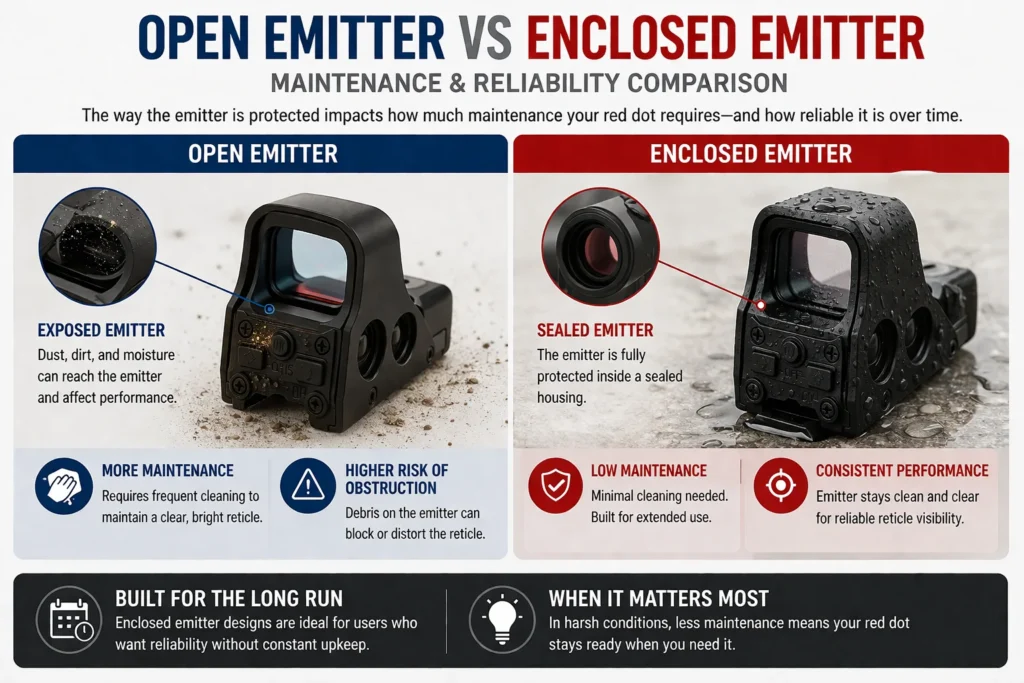
Open emitter optics use a partially exposed LED emitter positioned below the lens. This allows for compact size and a wider field of view.
Advantages:
- Lighter weight ⚖️
- Wider viewing window 👁️
- Lower profile design
Limitations:
- Emitter exposed to debris
- Requires more cleaning
- Performance can degrade in harsh conditions
🔒 Enclosed Emitter Red Dot
Enclosed emitter optics seal the emitter inside a fully enclosed housing. This design protects the optical system from external elements.
Advantages:
- Superior durability ⚙️
- Protected from water, dust, and dirt
- Consistent reticle performance
Limitations:
- Slightly heavier
- Typically larger form factor
🎯 Buying Criteria: What Actually Matters
🌧️ Environmental Resistance
If your optic will be used outdoors, exposure to rain, dust, or mud is inevitable. Enclosed emitters provide significantly better protection in these conditions.
🧼 Maintenance Requirements
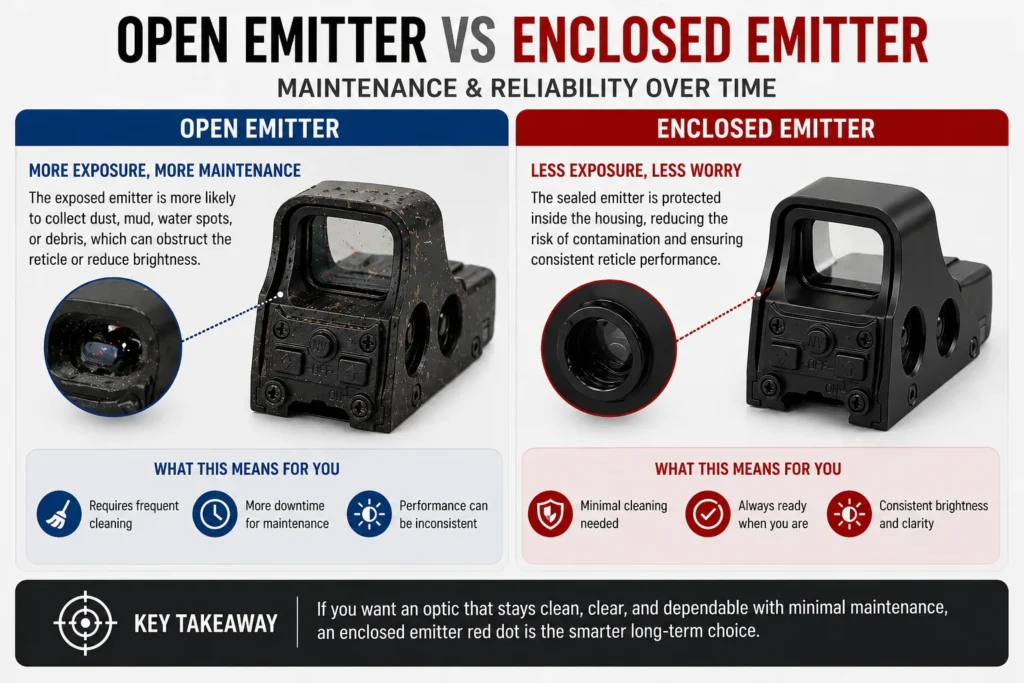
Open emitters require more frequent cleaning. Dirt or water on the emitter can distort or block the reticle.
Enclosed systems reduce maintenance, making them ideal for long-term reliability.
⚖️ Size and Weight
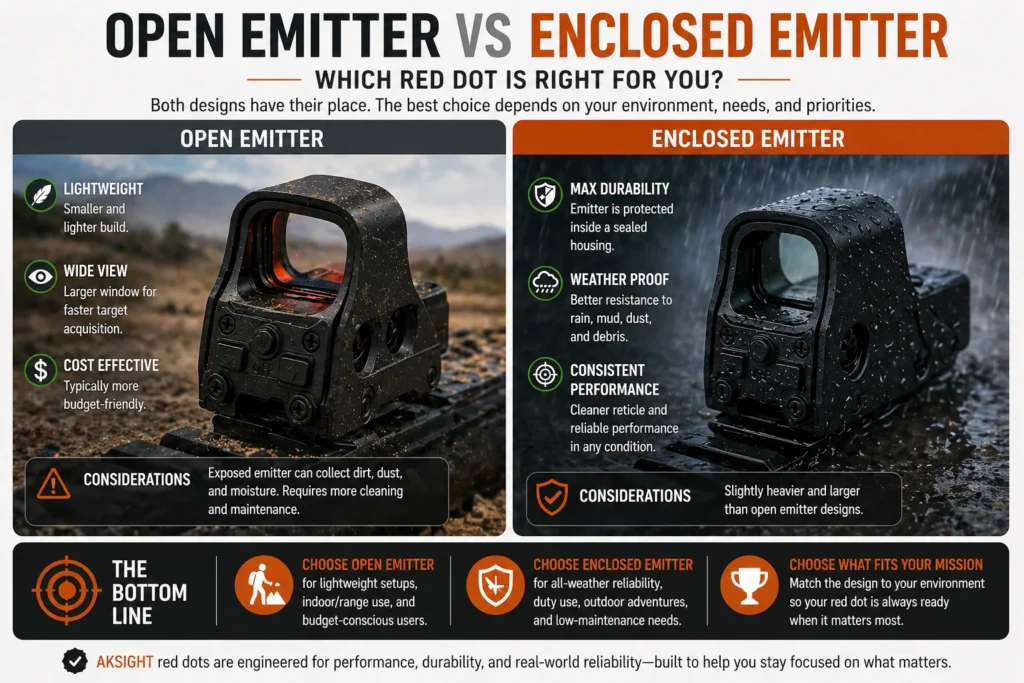
Open emitter optics are typically smaller and lighter. This matters for compact setups and lightweight builds.
🧱 Durability and Shock Resistance
Enclosed emitter designs generally offer better structural integrity. Combined with aluminum housings and proper sealing, they handle recoil and impact more consistently.
🌫️ Optical Clarity
Both designs can offer excellent clarity, but enclosed systems maintain consistent performance in adverse conditions.
👥 Who Should Choose Which?
| User Type | Recommended Type | Reason |
|---|---|---|
| Casual / Range Use | Open Emitter | Lightweight and cost-effective |
| Outdoor Enthusiast | Enclosed Emitter | Better protection in weather |
| Professional Use | Enclosed Emitter | Reliability in all conditions |
| Lightweight Setup Focus | Open Emitter | Smaller footprint |
| All-Weather Reliability | Enclosed Emitter | Sealed system prevents failure |
📊 Product-Level Comparison
| Feature | Open Emitter | Enclosed Emitter |
|---|---|---|
| Emitter Protection | Exposed | Fully sealed |
| Durability | Moderate | High |
| Weight | Lighter | Slightly heavier |
| Maintenance | Frequent cleaning | Low maintenance |
| Weather Resistance | Limited | Excellent (IP-rated) |
| Zero Retention | Good | More consistent |
❓ FAQ: Open Emitter vs Enclosed Emitter Red Dot
❓ Which is more reliable?
Enclosed emitter designs are generally more reliable due to sealed protection against debris and moisture.
❓ Do open emitter optics lose zero easily?
No, but environmental interference can affect reticle visibility, which impacts usability rather than zero itself.
❓ Are enclosed emitter optics worth the extra cost?
For demanding environments, yes. The added durability and consistency justify the investment.
❓ Is there a difference in optical clarity?
Under ideal conditions, both perform well. In harsh conditions, enclosed optics maintain clarity better.
❓ Which is better for beginners?
Open emitter optics are often more affordable and simpler, making them a good starting point.
🧭 Final Thoughts: Open Emitter vs Enclosed Emitter Red Dot
The decision between an open emitter vs enclosed emitter red dot comes down to your environment and reliability needs.
If you prioritize lightweight design and simplicity, open emitter optics remain a solid choice. But for long-term durability, consistent performance, and minimal maintenance, enclosed emitter systems are quickly becoming the preferred solution.
At AKSIGHT, we focus on rugged optical systems engineered for real-world performance. From precision lens coatings to reinforced housings and OEM/ODM customization 🧩, every design is built for clarity, reliability, and repeatable performance.