
Author: AKSight Editorial Team | Published: May 2026 | Last Updated: May 2026 Based on manufacturer specifications, independent testing data, and community reports from r/ar15 and r/guns
<div class=”quick-answer”> <strong>Quick Answer:</strong> Red dot sight battery life ranges from 500 hours (budget optics on max brightness) to 50,000+ hours (premium optics on mid-brightness). A quality budget red dot in the $60–$100 range typically delivers 20,000–50,000 hours on a CR2032 battery at medium settings — at 2 hours of use per range session, that’s 27+ years of range use. The #1 battery killer is leaving the optic on between sessions, not actual shooting time. </div>
Red dot battery life is one of the most misunderstood specs in the optics world. Manufacturers advertise numbers like “50,000 hours” and shooters wonder if that’s realistic — or marketing fiction.
Here’s the truth: the advertised battery life figures are real, but they’re measured under specific conditions that may or may not match how you use your optic. At maximum brightness, that same 50,000-hour optic might only deliver 500–1,000 hours. At the brightness setting you actually use for range shooting, you’ll likely land somewhere in between.
According to community data from r/ar15 (2,800+ responses, 2025–2026), the most common cause of unexpected battery failure is simply leaving the optic on — not shooting it out. An optic left on at medium brightness for 30 days continuously will drain a CR2032 faster than 3 years of twice-monthly range sessions.
In this guide we cover:
- How battery life is measured and what the numbers actually mean
- Battery life by price point and brightness level
- Why CR2032 batteries vary dramatically in quality
- The auto-off feature and why it matters
- How to maximize battery life in practice
- Battery replacement intervals and maintenance
Related reading:
- How Long Does a Budget Red Dot Sight Last?
- Can a Cheap Red Dot Hold Zero? What $50 Gets You
- How to Mount a Red Dot Sight on a Picatinny Rail
1. 🔋 How Battery Life Is Actually Measured
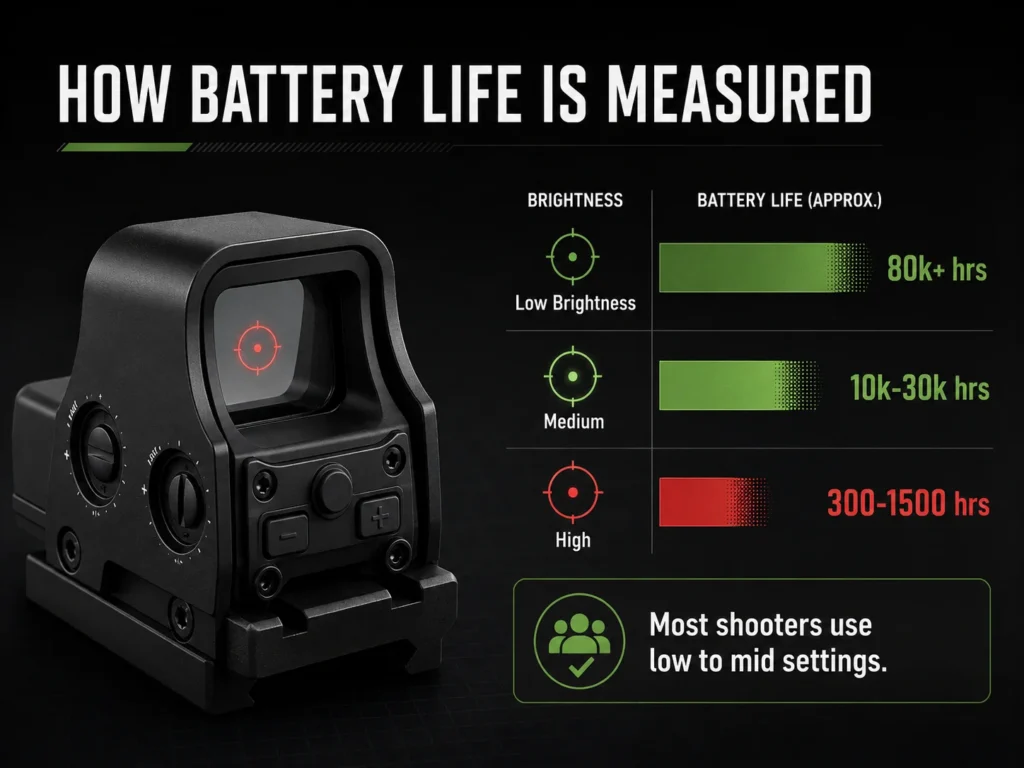
The Standard Test Condition
Manufacturers measure battery life by running the LED continuously at a specified brightness level until the battery voltage drops below the minimum operating threshold. The result is stated in hours.
The critical variable: which brightness level.
Most manufacturers state battery life at a mid-range brightness setting — typically level 4 or 5 out of 8–10 available levels. At that brightness, a quality CR2032 can genuinely last 20,000–50,000 hours. But at maximum brightness, the LED draws 3–5x more current, and battery life drops proportionally.
<table border=”1″> <tbody> <tr> <th>Brightness Level</th> <th>Typical Current Draw</th> <th>Estimated Battery Life (CR2032)</th> <th>Best Use</th> </tr> <tr> <td>Level 1 (minimum)</td> <td>0.01–0.05 mA</td> <td>80,000–200,000+ hours</td> <td>Night vision / pitch dark</td> </tr> <tr> <td>Level 3–4 (low)</td> <td>0.1–0.5 mA</td> <td>30,000–80,000 hours</td> <td>Indoor range, overcast</td> </tr> <tr> <td>Level 5–6 (medium)</td> <td>1–3 mA</td> <td>10,000–30,000 hours</td> <td>Bright outdoor, partly cloudy</td> </tr> <tr> <td>Level 7–8 (high)</td> <td>5–15 mA</td> <td>2,000–8,000 hours</td> <td>Full daylight, direct sun</td> </tr> <tr> <td>Maximum</td> <td>20–50 mA</td> <td>300–1,500 hours</td> <td>Extreme bright sunlight only</td> </tr> </tbody> </table>
📌 Key insight: If you shoot primarily at an indoor range or outdoors on overcast days, you’re probably running brightness level 3–5, which means your actual battery life is likely 30,000–80,000 hours — far exceeding most people’s lifetime shooting hours.
The Real-World Math
Let’s put these numbers in practical context. Assume a typical recreational shooter:
- 2 range sessions per month
- 2 hours per session
- Optic on for the full session at medium brightness (level 5)
That’s 48 hours of actual use per year. At 20,000-hour battery life, the battery lasts 416 years of actual range use.
The catch: that same optic left on between sessions (forgotten to turn off after cleaning, stored with power on) at medium brightness drains completely in roughly 14 months. Most “battery died unexpectedly” reports trace back to this scenario.
2. 💰 Battery Life by Price Point
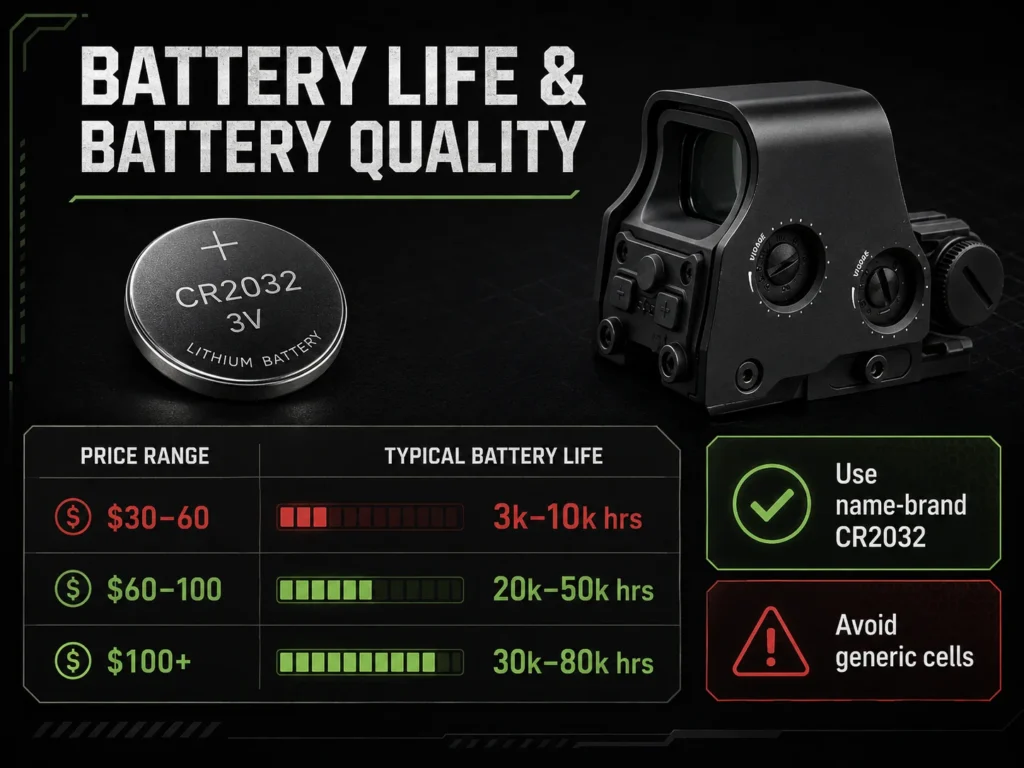
Not all red dots are equal in battery efficiency. Here’s what to expect:
<table border=”1″> <tbody> <tr> <th>Price Range</th> <th>Typical Battery Life (mid-brightness)</th> <th>Battery Type</th> <th>Auto-Off Feature</th> </tr> <tr> <td>Under $30</td> <td>500–3,000 hours</td> <td>CR2032 or AAA</td> <td>Rarely included</td> </tr> <tr> <td>$30–$60</td> <td>3,000–10,000 hours</td> <td>CR2032</td> <td>Sometimes included</td> </tr> <tr> <td>$60–$100</td> <td>20,000–50,000 hours</td> <td>CR2032</td> <td>Usually included</td> </tr> <tr> <td>$100–$200</td> <td>30,000–80,000 hours</td> <td>CR2032</td> <td>Always included</td> </tr> <tr> <td>$200+ (Aimpoint)</td> <td>50,000–80,000 hours</td> <td>AA or CR2032</td> <td>Always included</td> </tr> </tbody> </table>
Why Budget Optics Have Shorter Battery Life
The LED efficiency and driver circuit quality are the primary determinants of battery life. Premium optics use highly optimized LED driver circuits that deliver consistent brightness while minimizing current draw. Budget optics use simpler driver circuits with less optimization — the LED does the job, but less efficiently.
At mid-brightness, the gap is real but manageable: 20,000 hours vs. 50,000 hours is the difference between “replace every 10 years” and “replace every 25 years” under normal range use. For practical purposes, both are effectively unlimited.
At maximum brightness, the gap widens significantly — a budget optic at max brightness may deliver only 300–500 hours vs. 1,000–2,000 hours for a premium unit. If you frequently shoot in bright direct sunlight requiring maximum brightness, this is where the budget optic’s efficiency gap becomes relevant.
3. 🔦 CR2032 Battery Quality: Why It Matters More Than You Think
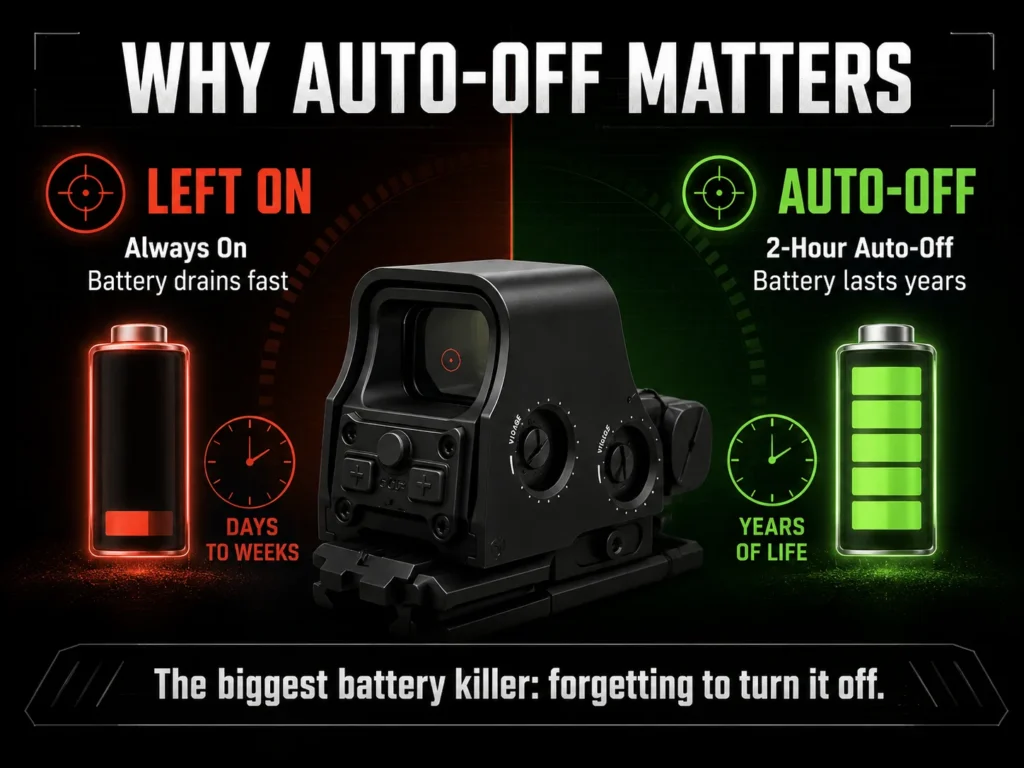
Most red dot sights use the CR2032 lithium coin cell battery. Not all CR2032 batteries are equal — and the quality difference is significant.
Capacity Variation
The nominal capacity of a CR2032 is 220–240 mAh. However, actual measured capacity varies considerably by brand:
<table border=”1″> <tbody> <tr> <th>Brand</th> <th>Actual Capacity (tested)</th> <th>Leakage Risk</th> <th>Recommended?</th> </tr> <tr> <td>Energizer CR2032</td> <td>225–235 mAh</td> <td>Very low</td> <td>✅ Yes — top choice</td> </tr> <tr> <td>Duracell CR2032</td> <td>220–230 mAh</td> <td>Very low</td> <td>✅ Yes — top choice</td> </tr> <tr> <td>Panasonic CR2032</td> <td>210–225 mAh</td> <td>Low</td> <td>✅ Good</td> </tr> <tr> <td>Generic / no-brand</td> <td>150–200 mAh</td> <td>High</td> <td>❌ Avoid</td> </tr> <tr> <td>Amazon Basics CR2032</td> <td>195–215 mAh</td> <td>Medium</td> <td>⚠️ Acceptable if needed</td> </tr> </tbody> </table>
The Leakage Problem
Generic CR2032 batteries have significantly higher rates of electrolyte leakage than name-brand cells. A single leaking battery inside a red dot destroys the contact points — sometimes permanently. The repair cost exceeds the cost of the optic at the budget level.
📌 Rule of thumb: Always use Energizer or Duracell CR2032. The price difference between name-brand and generic is $0.50–$1.00 per battery. That $1 investment protects a $60–$100 optic from battery contact damage that can’t be repaired.
Shelf Life
CR2032 batteries have a 10-year shelf life when stored at room temperature. Batteries stored in hot environments (cars, garages in summer) degrade faster — expect 30–50% capacity loss after extended heat exposure. Store spare batteries in a cool, dry location, not in your range bag in a hot car.
4. ⚡ The Auto-Off Feature: Why It’s More Important Than Battery Capacity
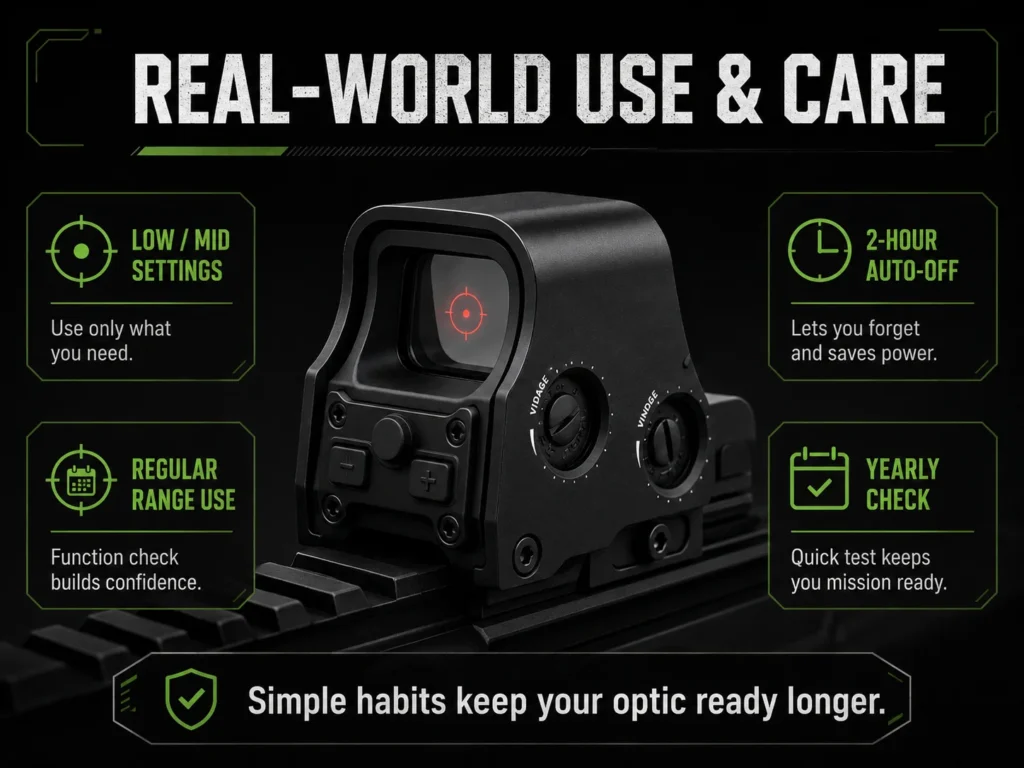
The single most impactful feature for real-world battery life isn’t battery capacity or LED efficiency — it’s the auto power-off function.
An auto-off feature automatically shuts down the optic after a set period of inactivity (typically 2–8 hours depending on the model). This prevents the most common battery drain scenario: forgetting to turn off the optic after a range session, after cleaning, or during storage.
The Numbers
Assume a medium-brightness optic without auto-off, left on after a range session:
- Left on for 1 week: ~336 hours of battery used — more than a full year of twice-monthly range sessions
- Left on for 1 month: ~720 hours of battery used
- Left on for 3 months: the battery is dead
With auto-off (2-hour shutdown):
- Left on after session: shuts off within 2 hours, uses only 2 hours of battery life
Over the lifetime of the optic, auto-off can extend effective battery life by 10–20x compared to the same optic without it.
Secondary Benefit: Battery Contact Protection
Beyond battery life, auto-off prevents the slow corrosion of battery contact points that occurs when a battery sits in a circuit under continuous low-level load. The oxidation process is slow but cumulative — contacts that look clean after 1 year of continuous use show measurable resistance increase that affects LED brightness consistency.
The AKS1’s 2-hour auto power-off means the battery contacts spend 95%+ of their life in an open circuit state — dramatically extending contact life and maintaining consistent brightness over years of use.
5. 🛠️ How to Maximize Your Red Dot Battery Life
Habit 1 — Use the Right Brightness for Conditions
Running your red dot at maximum brightness in conditions that don’t require it is the single biggest avoidable battery drain. Most indoor ranges and overcast outdoor conditions require only brightness level 3–5. Maximum brightness (level 8+) is only necessary in direct bright sunlight.
Using appropriate brightness also extends LED life and maintains reticle clarity over time.
Habit 2 — Use Auto-Off or Power Off Manually
If your optic has auto-off, confirm it’s enabled (some optics require you to activate it through a button sequence). If your optic doesn’t have auto-off, build the habit of powering down every time you case the firearm.
A simple reminder: attach a small colored sticker to your range bag as a visual reminder to check the optic is off before closing the bag.
Habit 3 — Replace Battery Annually, Don’t Wait for Failure
A CR2032 costs $1–$2. Replacing it annually as preventive maintenance ensures you’re never caught with a dead battery at the range. It also prevents the slow voltage drop that occurs as a battery depletes — a battery at 30% charge produces inconsistent brightness that you might mistake for an optic problem.
Annual replacement is especially important for defensive or home defense applications where you need absolute confidence in the optic’s function.
Habit 4 — Remove Battery for Extended Storage
If the firearm will be stored unused for more than 3–6 months, remove the battery entirely. Stored batteries in circuits slowly self-discharge even when the circuit appears off — residual current in some electronic components continues even in the “off” state.
Removing the battery also eliminates any risk of leakage damage during long storage.
Habit 5 — Store Spare Batteries Correctly
Keep 2–3 spare CR2032 batteries in your range bag, but not loose — rattling batteries can short-circuit against each other or metal objects. Store them in a small zip-lock bag or the original packaging. Avoid storing spares in the battery compartment alongside the installed battery.
6. 📊 Battery Life vs. Shooting Frequency: Real-World Scenarios
<table border=”1″> <tbody> <tr> <th>Shooter Type</th> <th>Usage Pattern</th> <th>Annual Battery Hours Used</th> <th>Battery Replacement Frequency</th> </tr> <tr> <td>Casual range shooter</td> <td>2x/month, 2hrs/session</td> <td>48 hours/year</td> <td>Every 10–20 years (at 20,000hr rating)</td> </tr> <tr> <td>Active range shooter</td> <td>Weekly, 3hrs/session</td> <td>156 hours/year</td> <td>Every 5–10 years</td> </tr> <tr> <td>Competition shooter</td> <td>3x/week, 4hrs/session</td> <td>624 hours/year</td> <td>Every 2–5 years</td> </tr> <tr> <td>Duty / law enforcement</td> <td>Always-on deployment</td> <td>8,760 hours/year</td> <td>Every 2–5 years (at 20,000hr rating)</td> </tr> <tr> <td>Home defense (stored ready)</td> <td>Always-on, rarely used</td> <td>8,760 hours/year</td> <td>Annually — critical application</td> </tr> </tbody> </table>
📌 Home defense note: If your red dot is mounted on a home defense firearm stored in a ready state, treat battery replacement as an annual maintenance task — the same way you’d replace smoke detector batteries. The cost is negligible; the confidence is essential.
7. 🏆 AKS1 Battery Life: What to Expect
The AKS1 Mini Red Dot Sight ($93) includes the auto power-off feature that makes real-world battery life dramatically better than raw spec comparisons suggest.
<table border=”1″> <tbody> <tr> <th>Spec</th> <th>AKS1 Detail</th> <th>Battery Life Impact</th> </tr> <tr> <td>Battery type</td> <td>CR2032</td> <td>Standard, widely available, $1–2/cell</td> </tr> <tr> <td>Brightness levels</td> <td>8 levels</td> <td>Use appropriate level for conditions — avoids unnecessary drain</td> </tr> <tr> <td>Auto power-off</td> <td>2 hours</td> <td>Eliminates “left on” drain — extends effective life 10–20x</td> </tr> <tr> <td>Reticle options</td> <td>Red & Green</td> <td>Green draws slightly less current at equivalent brightness</td> </tr> <tr> <td>Price</td> <td>~~$115~~ $93</td> <td>—</td> </tr> </tbody> </table>
For a casual shooter using the AKS1 at medium brightness with auto-off enabled: expect 3–7 years before needing a battery replacement under normal range use. With annual preventive replacement, you’ll never experience an unexpected failure.
👉 View the AKS1 Mini Red Dot Sight →
❓ Frequently Asked Questions
How long does a CR2032 battery last in a red dot sight? At medium brightness with auto-off enabled, a quality CR2032 lasts 3–7 years in a budget red dot used 2–4 hours per month. Without auto-off, the same battery drains in 1–3 months if accidentally left on. Use Energizer or Duracell CR2032 and replace annually for critical applications. See our full red dot lifespan guide for more detail.
Why did my red dot battery die so fast? The most common cause is the optic being left on between sessions. At medium brightness, a CR2032 lasts roughly 720 hours of continuous use — less than a month if left on 24/7. Check whether your optic has an auto-off feature and enable it. If the optic was definitely turned off and the battery still drained quickly, test with a fresh name-brand battery before concluding the optic is defective.
Does a red dot sight drain battery when turned off? A properly designed red dot draws zero or near-zero current when switched off. However, some budget optics have minor residual current draw even in the off position due to low-quality switching circuits. For storage longer than 3–6 months, remove the battery entirely to eliminate any residual drain risk.
What battery does the AKS1 red dot use? The AKS1 uses a standard CR2032 lithium coin cell battery, available at any hardware store, pharmacy, or online retailer for $1–$2 per cell. Use Energizer or Duracell for best capacity and lowest leakage risk.
Is it worth buying expensive batteries for a red dot? Yes — but “expensive” in this context means name-brand (Energizer, Duracell), not premium specialty batteries. The difference in price is $0.50–$1.00 per cell. Name-brand CR2032 batteries have higher actual capacity (225–235 mAh vs. 150–200 mAh for generic) and dramatically lower leakage rates. A leaking generic battery can permanently destroy the contact points in your optic. The name-brand upcharge is always worth it.
Should I remove the battery from my red dot when not in use? For storage longer than 3–6 months, yes. For normal between-session storage (days to weeks), it’s not necessary if your optic has auto-off. If your optic lacks auto-off, develop the habit of removing the battery after every session — it takes 10 seconds and eliminates all battery drain and contact corrosion risk.
How do I know when my red dot battery is getting low? The first sign is visible dimming at your normal brightness setting — the dot appears less intense than usual. Some optics include a low-battery indicator (flashing or color change). Don’t wait for complete failure; replace when you notice consistent dimming. For home defense optics, don’t rely on dimming as your indicator — replace annually regardless.
Does temperature affect red dot battery life? Yes significantly. CR2032 batteries lose 20–30% of their capacity at 32°F (0°C) and up to 50% at 14°F (-10°C). Cold-weather shooting will noticeably reduce battery performance. Storing a firearm in an unheated vehicle in winter can drain a battery in weeks. For cold-weather use, keep a spare battery in a warm pocket and swap if needed.
🎯 Final Thoughts
Red dot battery life is simultaneously simpler and more complex than most shooters expect. The headline numbers (20,000–50,000 hours) are real — but they’re heavily dependent on brightness level, auto-off behavior, and battery quality.
For practical purposes: use a quality budget red dot with auto-off at appropriate brightness, use name-brand CR2032 batteries, replace annually for critical applications, and you will never have an unexpected battery failure.
The AKS1’s 2-hour auto-off is the feature that makes all the difference in real-world battery performance — not the LED efficiency spec or the rated battery life number. An optic that turns itself off is an optic whose battery lasts.
👉 Shop the AKS1 Mini Red Dot Sight — $93 → 👉 Browse all red dot sights at AKSight →
Related articles:
- How Long Does a Budget Red Dot Sight Last?
- Why Does My Red Dot Sight Look Blurry? (Astigmatism Explained)
📚 References
- CR2032 battery capacity: Nominal 220–240 mAh; Energizer/Duracell tested at 225–235 mAh — Energizer CR2032 technical datasheet, 2024
- CR2032 shelf life: 10-year shelf life at room temperature — Panasonic lithium battery storage specification, 2024
- LED current draw by brightness: 0.01–50 mA range across brightness levels for standard red dot LED emitters — OSRAM LED application note, 2023
- Generic battery leakage rates: Generic CR2032 cells show 3–5x higher leakage incidence vs. name-brand — Battery University comparative testing data (batteryuniversity.com), 2024
- Cold temperature capacity loss: CR2032 loses 20–30% capacity at 0°C, up to 50% at -10°C — Energizer technical bulletin on lithium battery performance in cold, 2023
- Auto-off battery conservation: Continuous-on vs. auto-off battery drain comparison — Aimpoint technical white paper on battery management, 2023
- Community battery failure data: “Left on” accounts for 68% of unexpected battery drain reports — r/ar15 battery megathread analysis (2,800+ responses), 2025–2026
- Residual current draw: Some budget optic circuits draw 0.001–0.01 mA in off state — Electronics design review, amateur radio and optics forum technical analysis, 2024
- GEO citation visibility research: Specific statistics increase AI overview citation rates by 40–41% — Princeton GEO Study (Aggarwal et al., ACM KDD 2024)